Energy-efficient heat recovery
for foundries

STIHL uses recovered process heat from production exhaust air to heat the entire die casting foundry in winter via a central production hall ventilation system –
efficiently, at a large scale, and without conventional production hall heating.

Cleverly utilize process heat in the foundry like STIHL

At STIHL’s magnesium die-casting plant in Weinsheim, KMA combines exhaust air treatment with heat recovery.

A total of twelve KMA-ULTRAVENT systems on the hall roof purify the exhaust air and recover its heat. This heat is used to warm the fresh air for the hall. In addition, waste heat is recovered from the cooling water of the casting machines.

As a result, the hall maintains a constant temperature of 18 °C throughout the winter months without the need for conventional energy sources such as electricity or gas.

Icon-Industry-Accent

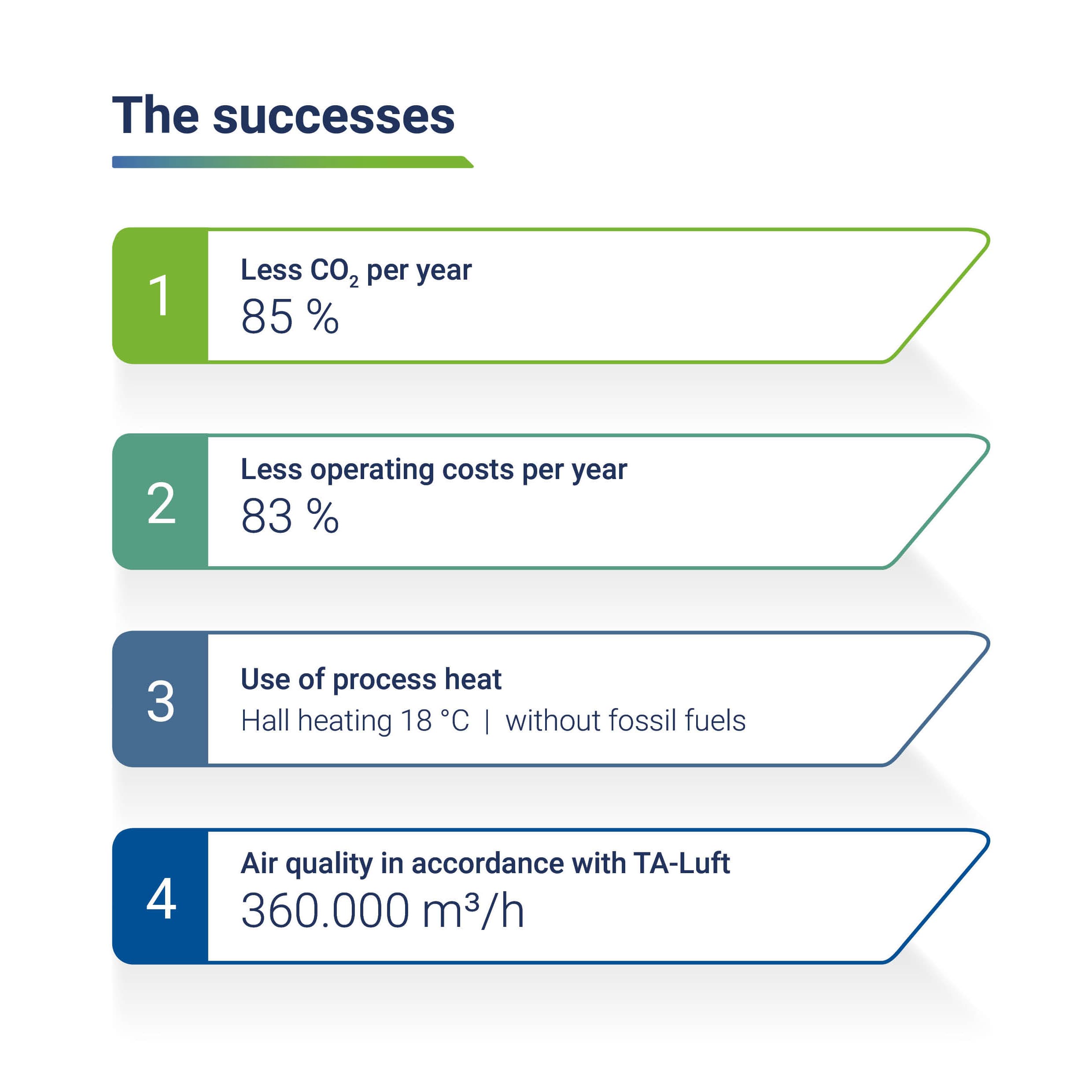
- 85% less
CO₂ emissions

From 363 to 55 tons of CO₂ – heating without conventional production hall heating

Icon-Energy-Accent

- 83% less
energy costs

Drastically reduce operating costs: approx. €5,900 instead of around €36,000 per year.

Icon-Heat-Exchanger-Eco-accent-light

1,350 kW/h heat recovery

Pure air & constant 18 °C – without conventional energy sources
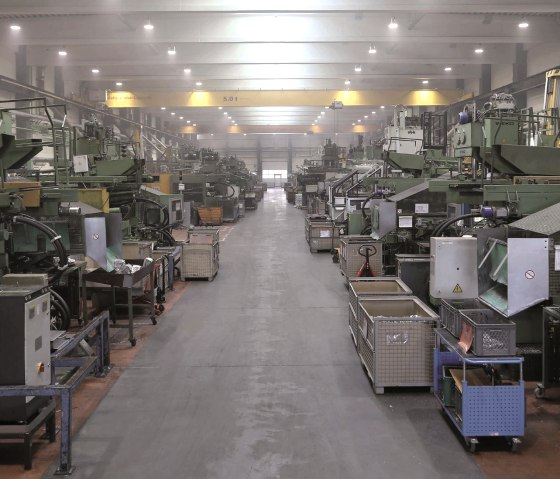
With a casting capacity of approximately 6,000 tonnes per year, the STIHL plant is now regarded as one of the largest and most modern magnesium die-casting plants in Europe. It operates 20 die-casting machines using hot-chamber and cold-chamber technology, with clamping forces of up to 1,000 tonnes. Around 800 employees produce over 26 million components annually for chainsaws and other power tools manufactured by the parent company, as well as for external customers.

An exhaust air filter system with strong eco-efficiency for reliable exhaust air filtration and powerful heat recovery was sought.

Large Magnesium Die Casting Plant with Layer Ventilation

The Initial Situation in the STIHL Foundry

The STIHL magnesium die casting plant in Weinsheim, Rhineland-Palatinate

Top 3 Pain Points at STIHL

Emission Limit Values

Due to high smoke pollution a 13-fold hourly air exchange takes place in the foundry. This corresponds to an air flow of 360,000 m³/h.

Without Fossil Fuels

The die casting foundry is to be heated to a constant 18 °C during the winter months – without conventional energy sources

High CO₂ Emissions

Energy prices and CO₂ costs are rising. A gas-fired heating system would produce around 363 tonnes of CO₂ per year.
The Potential for a Die Casting Plant

Multi-stage recovery of valuable process waste heat

The company is committed to a high level of environmental protection and energy efficiency and their continuous improvement, both in corporate processes and in products. In accordance with these principles, great importance was attached to eco-efficiency when selecting a new exhaust air filter system. The following factors were in focus:

  • Effective exhaust air treatment including consideration of the existing supply air system with layer ventilation
  • Heat recovery for increased energy efficiency
  • CO₂-saving process without secondary emissions
  • Elimination of conventional production hall heating

“Our system is proof that sustainable production becomes concretely measurable: less CO₂, highly efficient use of existing process heat, and independence from fossil fuels in production hall heating.”

Hartmut Fischer, Managing Director, ANDREAS STIHL AG & Co. KG
Magnesium die-casting plant

Enormous Cost and CO₂ Reduction

The Achievements for STIHL's Foundry

Occupational Health and Safety 360,000 m³/h clean production hall air

- Oily smoke and aerosols are filtered directly from the process exhaust air – with a 13-fold air exchange per hour. This reduces odor pollution and creates noticeably better working conditions.

Energy Efficiency 1,350 kW/h from waste heat instead of gas

- The recovered process heat heats the entire die casting foundry to a constant 18 °C in winter – completely without fossil fuels.

Using waste heat reduces energy costs

Operating costs are significantly lower without the need for hall heating: around €5,900 instead of around €36,000 per year.

Environmental Protection 308 tons less CO₂ – every year

- 85% lower CO₂ emissions compared to conventional production hall heating, while maintaining EU-compliant pure air quality.

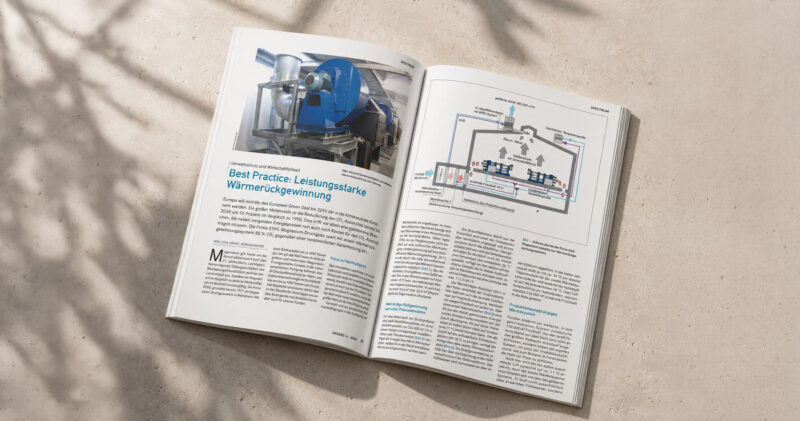
The project in Weinsheim was published in the trade magazine GIESSEREI as “Best Practice: Powerful Heat Recovery”. Download the complete case study now and find out why this efficiency project is receiving special attention in the industry.

How we successfully supported STIHL

Download Trade Publication: Best Practice Powerful Heat Recovery

Our Solution for STIHL's Magnesium Die Casting Plant

Modern Supply Air and Exhaust Air Filter System with Heat Recovery

Exhaust Air

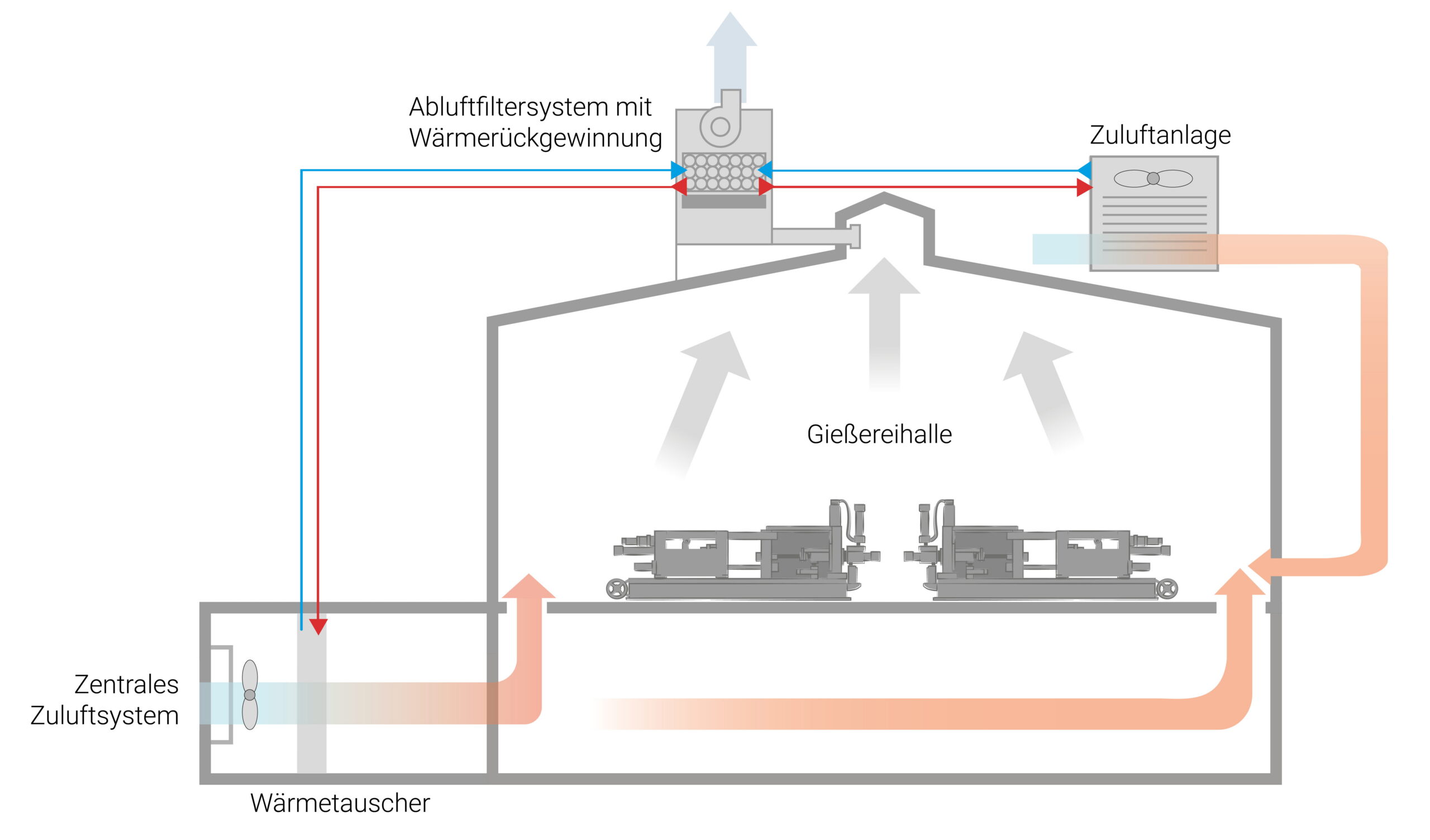
KMA exhaust air filter system with an integrated heat exchanger, with an exhaust air flow rate of 360,000 m³ per hour.

The exhaust air, which is contaminated with oil fumes, is extracted from beneath the hall ceiling. It first passes through the exhaust air filters. The heat exchanger then extracts the heat from it. Due to the fume contamination, the air in the hall is replaced 13 times an hour.

Improved pure air quality in the foundry and better protection at the workplace

Compliance with EU emission limit values

Energy-efficient operation of the filter systems

Supply Air

A supply air system combined with a heat recovery system for energy-efficient stratified ventilation of the production hall.

The twelve systems on the roof operate in two groups. Eight are connected to the central supply air system. Four form a separate system. This keeps the hall frost-free even when production is at a standstill, for example during the holidays.

Utilization of process heat for sustainable production hall heating

Supply of supply air via layer ventilation

Integration of the existing supply air system

“Efficient energy use must be considered holistically. That’s why we combine heat recovery, exhaust air filtration, and production hall heating for our plant in an ecologically and economically sensible way.”

Thomas Gülich, Head of Technology and Production Processes, ANDREAS STIHL AG & Co. KG

clean air.
save energy.

>3,000

Systems installed worldwide

80 %

Energy savings possible compared to conventional exhaust air technology

360°

Emissions, exhaust air and energy. Engineered together.

1,500 +

Customers worldwide trust our technology

DO YOU HAVE QUESTIONS?

Frequently Asked Questions about Heat Recovery at STIHL

Yes — every foundry has hot, emission-laden exhaust air, and that’s exactly where the STIHL system draws its heat; the principle is independent of the casting process. The heat recovery is flexible: it doesn’t have to flow into production hall heating, but can also supply supply air, process water, or processes — energy is energy. The exhaust air volume and temperature, your site’s heat demand, and the building situation are decisive for transferability. We assess the potential of your process heat based on your real operating data.

Yes — at STIHL, the existing supply air system with layer ventilation was integrated instead of replaced. Twelve exhaust air filter systems on the production hall roof feed the central supply air system via heat exchangers; additionally, the waste heat from the die casting machines’ cooling water circuit was integrated into the system. This way, the process exhaust air heats the production hall to a constant 18 °C in winter — without conventional energy sources. We will check the integration of your existing technology as part of the system design.

Yes — fire detectors and active extinguishing systems can be integrated directly into the filter system as modules, supplemented by pressure shock resistant design, rupture discs, and explosion suppression. Magnesium is flammable and reacts violently with oxygen and water at high temperatures — fire protection is therefore designed along the entire process chain from detection to the filter. The STIHL magnesium die casting plant with over 20 die casting machines serves as a reference for series production. We develop the protection concept for your plant together with specialized fire protection partners.

No, neither upwards nor downwards. Our ULTRAVENT® filter systems cover the entire range, from individual machines with a few thousand cubic meters per hour to large-scale systems with several hundred thousand. They are modular in design and freely combinable, so that virtually any exhaust air volume can be mapped. For large volumes, such as in megacasting, the horizontal-modular ULTRAVENT® H is available from 30,000 m³/h per unit and can be connected as desired — at STIHL to a total of 360,000 m³/h with a 13-fold air exchange. Crucial remains the smoke extraction at the source, as it keeps the necessary air exchange and thus the volume to be treated small. We dimension the system based on your emission sources and the required air exchange.

karem-kartal-kma

Kerem Kartal

Sales Manager
+49 2244 9248 42

Your direct contact

Talk to Kerem Kartal

Would you like to know how exhaust air filtration, heat recovery, supply air management and production hall heating can be sensibly combined in your foundry?

Then let’s work together to find the system concept that fits your site technically and energetically. The basis is always your real hall and process situation.

We are the expert

Further applications

Our solutions in the trade press

Publications & technical articles

More information

Downloads & links

Laws & guidelines

EU BREF Directive

TA-Luft: Air pollution control – emission limit

VDI 2262-3: Workplace air quality – pure-air recirculation

TRGS 900: Workplace limit values