








Exhaust Air Filtration &
Heat Recovery

for Industrial Fryers

KMA cleans fat- and odour-laden process exhaust air without burning fossil fuels — and recovers the heat for your production process. Your hot fryer exhaust air is an energy source.

Your Potential in Frying and Cooking

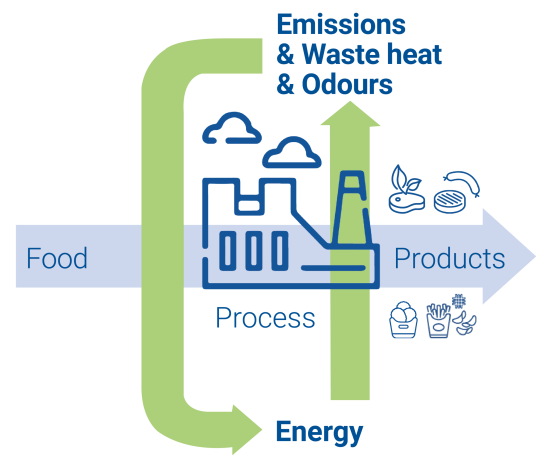
Fryer exhaust air: hot, greasy, odour-intensive — and full of valuable energy.

Potential-Lebensmittel-DE-Web-V2

The Obligation

The exhaust air reaches temperatures of up to 130 °C, is laden with fat aerosols and highly odour-intensive. Limit values under the Federal Immission Control Act (BImSchG), TA-Luft and GIRL apply. In practice, this often means 500 OU/m³ and 50 mg total carbon per m³.

The Opportunity

The process heat can be recovered. It can warm the supply air, heat water or charge a buffer tank.

The Solution

KMA combines both in a single system — without fossil fuels and with up to 98% less energy consumption than thermal oxidation. For schnitzel, burger patties, kebabs, meat alternatives, fries, chips and pancakes. Wherever industrial frying and cooking takes place.

✓ Recover process heat

✓ Comply with emission limit values

✓ Reduce odours

✓ Lower operating costs

Applications in Industrial Frying and Cooking

We've supported these frying and cooking applications.

Vegan Schnitzel,
Nuggets & More
Chicken Nuggets
Gyros, Kebab & More
Pancakes
& Pasta
Fish Fingers
Fried Cheese &
Convenience Food
French Fries
& Chips
Meat Specialties
& Grilled Dishes

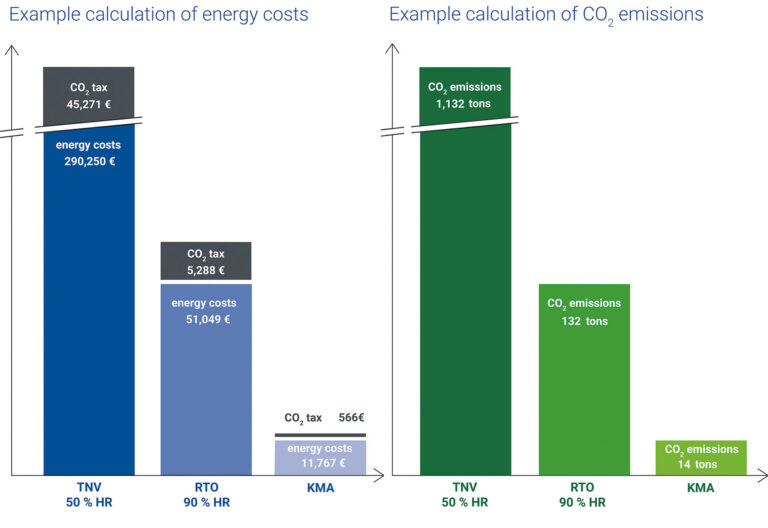
€350,000 or €12,500 in operating costs. You decide.

THE COST DIFFERENCE IN NUMBERS

Basis of Calculation

Natural gas price 5 cents/m³, electricity price 20 cents/kWh, EU CO₂ tax 2025: €55/tonne
Calculation examples and references published in the trade journal Fleischwirtschaft (3/2022, 5/2025).

Low Maintenance in Continuous Operation

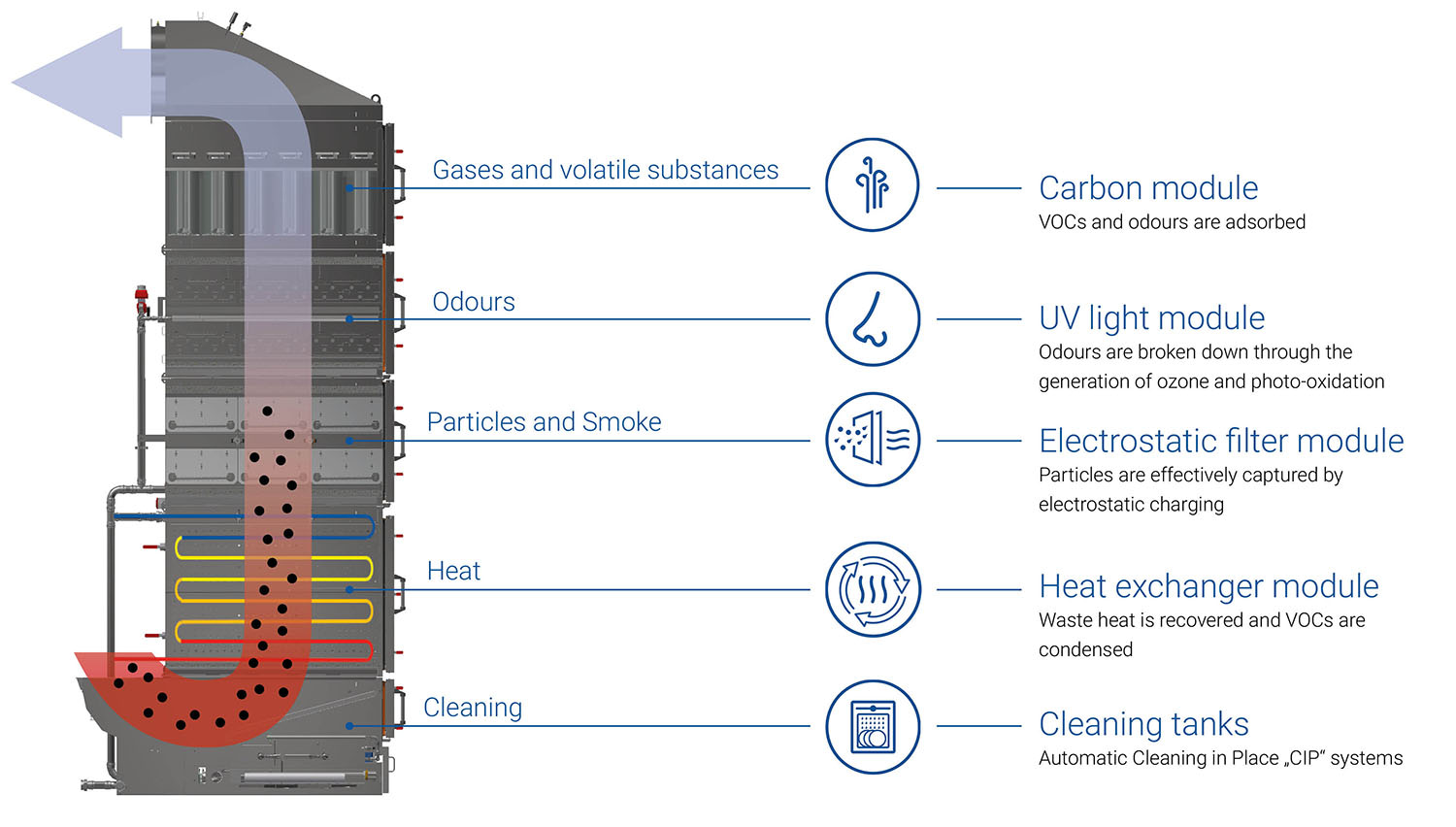
The CIP system cleans heat exchangers, electrostatic precipitators and UV light tubes fully automatically with moving nozzle arrays. No filter media changes, no dismantling — the cleaning fluid circulates between the cleaning tank and the filter system in a resource-efficient cycle.

Fewer CO₂ Emissions per Year

The 1,000+ tonnes of CO₂ saved per year pay off twice over: ecologically and economically.

Lower Your Operating Costs

Modern environmental technology is extremely economical in operation. The system burns no fossil fuels and operates entirely on electricity — the energy consumption of a filter cell for 5,000 m³/h of exhaust air is roughly equivalent to that of a 100-watt light bulb.

The production exhaust air is cleaned in compliance with TA-Luft and GIRL, and the recovered heat flows back into the supply air and process water — at a fraction of the operating costs and CO₂ emissions of thermal oxidation.

Since 2025, the CO₂ tax stands at €55/t and TA-Luft has been revised — tipping the economics against thermal oxidation units (TNV). One example: at 3,000 m³/h and 5,000 operating hours, a TNV (50% heat recovery) costs around €104,560/year, while the KMA solution costs €20,000 — with 90 kW/h of usable heat and a CO₂ balance of 1,393 → 95 t.
How this works in practice is described by KMA in the leading trade magazine Fleischwirtschaft, using the example of a Bavarian meat processor who replaced its thermal oxidation unit in four steps.

Time to Re-evaluate Your Thermal Oxidation Unit.

Are you operating a TNV for exhaust air filtration in your frying plant?

We put our trust in KMA

OUR SOLUTION for Industrial Frying and Cooking

One system. Five stages. No combustion — efficient & compact air volume.

No single process can handle greasy, hot, odour-intensive exhaust air on its own. The KMA ULTRAVENT® filter system combines several stages in one compact unit — on the roof or inside the production hall, directly above the emission sources. And it does what many alternatives cannot: it cools the exhaust air without diluting it.

Filter out
fat and particles

Recover
heat

Icon-Odours-Nose-V2-green-web

Reduce
odours

Icon-Limit-Values-green-web

Comply with
limit values

Our ULTRAVENT® M Solution Portfolio. Configurable to Your Needs.


The functional modules of the universal filter system: combinable as needed for exhaust air filtration and heat recovery across a wide range of industries and processes
Not Every Exhaust Air Stream Needs the Full Process Chain.

It always starts with fat. If the fat load isn’t properly separated, the problem simply shifts downstream — into UV tubes, carbon filters, ducts and fans. That’s exactly where our strength lies: the electrostatic precipitator removes fat aerosols and fine particles down to the submicron range from the exhaust air and is cleaned fully automatically by the CIP system. No filter media changes, no declining separation performance.

Everything else depends on your target value: clean gas requirements, odour load, humidity. Based on this, we add UV light, carbon, wet scrubber or heat recovery — and leave out what your case doesn’t need. Low-cost UV solutions cut corners on exactly the stage that determines service life. We cut costs on the stages your limit value doesn’t require.

Three typical cases from our practice:

Fat Load: LIGHT
Humidity: High
Odour: Moderate

Design target clean gas: < 500 OU/m³
typical for sites in industrial areas without sensitive buildings nearby

KMA Solution:
ULTRAVENT M
with wet scrubber module
Possibly UV light


Fat Load: High
Humidity: Moderate
Odour: Strong

Design target clean gas: 100–200 OU/m³
typical for industrial and commercial sites with mixed-use/residential buildings in the wider vicinity

KMA Solution:
ULTRAVENT M
with ESP
+ UV light
+ catalytic carbon

Fat Load: Very High
Humidity: High
Odour: Strong

Design target clean gas: < 100 OU/m³
typical for sites directly adjacent to residential buildings

KMA Solution:
ULTRAVENT M
with heat exchanger (dehumidification)
with ESP
+ UV light
+ storage carbon


clean air.
save energy.

>3.000

Systems installed worldwide

80 %

Possible energy savings compared to conventional exhaust air technology

360°

Emissions, exhaust air and energy thought together

1.500 +

Customers worldwide trust our technology

THE VOLUME FLOW ADVANTAGE

Why KMA keeps the air volume small — and others don't

Graphic-Process-Air-Admixture-vs-KMA-Process-DE

Processes with Air Dilution

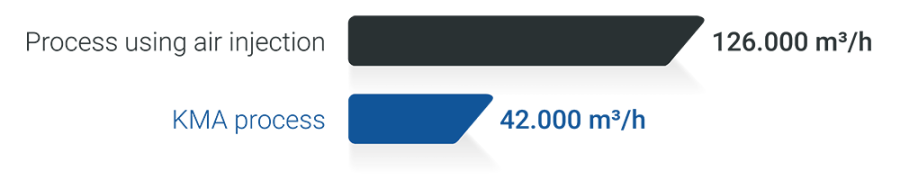
Systems without integrated heat recovery, such as plasma, ozone or pure UV light systems, cool by diluting the hot process exhaust air with large amounts of room air. A mixing ratio of 3:1 is often quickly required, tripling the operating volume. The extracted room air must then be continuously replaced with cooled or heated fresh air.

The result: larger exhaust air, supply air and ducting systems — and a permanent driver of energy consumption and costs.

The KMA Process

KMA doesn’t cool by dilution but by heat recovery: the heat exchanger extracts heat from the exhaust air via a coolant circuit, without mixing in room air. This keeps the volume flow rate exactly as large as the process requires. Ducts, fans and piping are sized to the actual exhaust air flow rate — not a multiple of it.

The volume stays small, and the extracted heat is put to use instead of being wasted.

Disadvantages for You

The tripled operating volume forces larger-dimensioned exhaust air, supply air and ducting systems.

The process heat remains unused. As a result, the extracted room air must be heated or cooled.

Your building systems remain locked in

Any change in room temperature or production scenario calls the design of the exhaust air system into question.

Advantages for You

The compact operating volume allows for leaner sizing of the air handling technology.

The energy from the warm process exhaust air is reused and supplies downstream processes.

Your building systems remain flexible

Room temperatures and production scenarios can be changed without redesigning the exhaust air system.

Sample Calculation

The dilution process moves approx. 80,000 m³/h of additional room air per hour (126,000 instead of 42,000 m³ in total).
Cooling from 20 to 7 °C requires 360 kW. Heating from 0 to 7 °C requires 190 kW.
At 6,912 operating hours per year, this equates to an additional air conditioning load of around 2,500 MWh.

Basis: 42,000 m³/h process exhaust air at 95 °C, mixing ratio 3:1.

CUSTOMER EXAMPLES Frying and Cooking

How Our Customers Benefit

Rügenwalder Mühle — Heat Returned to the Cleaning Water


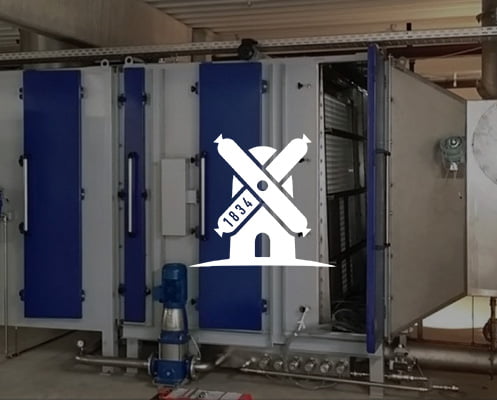
A KMA partner since 2002. For the odour-intensive meat alternatives produced in Bad Zwischenahn, an ULTRAVENT® H 30000 cleans the hot frying and cooking exhaust air (heat exchanger, electrostatic precipitator, UV light, carbon catalyst, CIP) and feeds the recovered heat into the cleaning water via a buffer tank.
(Fleischwirtschaft 5/2025)
Tönnies — Capacity Tripled, Energy Saved


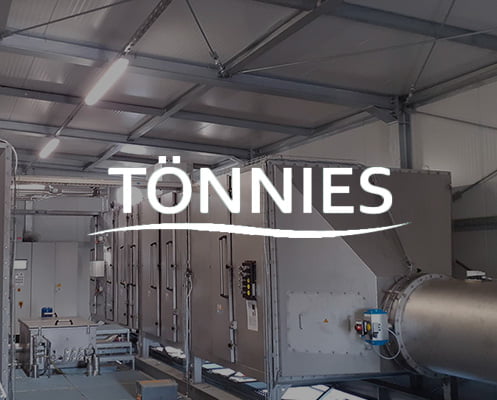
As part of a capacity expansion, Tönnies integrated nine fryers and cooking ovens into a KMA exhaust air system — two filter units with a capacity of up to 60,000 m³/h and integrated heat recovery for supply air and water. Instead of combustion: significantly better energy efficiency and a building block of the Agenda t30 sustainability strategy.
(Fleischwirtschaft 3/2022)
endori — Combustion-Free from the Start


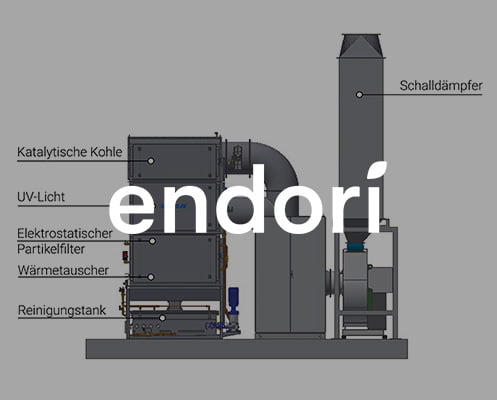
The pea protein pioneer decided against a thermal oxidation unit (TNV) right from its founding — opting instead for a multi-stage process without burning fossil fuels. The result: 80% savings in energy costs and CO₂ compared to a TNV, with reliable neutralisation of VOCs and odours.
(Fleischwirtschaft 5/2025)


Frequently Asked Questions About Exhaust Air Filtration and Heat Recovery for Fryers

Yes — KMA exhaust air filtration systems are designed independently of manufacturer and are in use on systems from all leading manufacturers (e.g. alco, Fessmann, GEA, Heat and Control, JBT, Kiremko, Marel, Maurer-Atmos, Rosenqvists, Schröter). What matters is not the manufacturer of the production equipment but the specific exhaust air conditions — in particular volume flow rate, temperature, and fat, moisture and odour load. This means the KMA solution can be designed for individual fryers and roasting systems just as well as for combined production lines with cooking, boiling or comparable thermal processes; humid or steam-rich exhaust air is a design consideration, not a disqualifying factor. For a reliable assessment, an initial overview of your equipment and process data is all that’s needed.

As a rule, the exhaust air technology is connected to the existing process without altering the actual production process itself. Extraction, filter stages and heat recovery are designed around the existing equipment and the spatial conditions on site.

The various filter stages are cleaned in place by the automatic KMA cleaning system, similar to a built-in dishwasher. This means regular replacement of conventional filter media, as required by other processes, is not necessary. Separated fat and oil components are removed from the air stream, discharged and collected in a collection tank within the system. Cleaning intervals and disposal depend on the product, operating hours and fat load.

The electrostatic principle operates virtually wear-free: systems with over 50,000 operating hours are documented. Thermal wear, as seen with thermal oxidation, does not occur, and separation performance remains constant with regular cleaning. UV tubes and carbon cartridges operate in the odour stages and are replaced on a scheduled basis.

KMA combines several cleaning stages for fat, particles, smoke and odour in one system. The electrostatic precipitator removes aerosols, fat and particles — gaseous odour compounds require a separate stage. For this, UV photo-oxidation, absorption-based wet scrubbers and an activated carbon stage are available, combined depending on odour load and target value. The specific design is based on the process emissions and the requirements applicable at the site, such as TA-Luft, BImSchG and odour assessment. Whether additional cleaning stages are required is therefore determined on a project-specific basis.

Yes. KMA filter systems are in use in numerous approved facilities as a replacement for thermal or catalytic thermal oxidation. A particularly strong example is the conversion at Hardy Remagen: it was funded under the German federal government’s Environmental Innovation Programme — explicitly recognised by the authorities as an alternative to thermal oxidation. We support you throughout the approval process: from design documentation and emissions forecasting to acceptance measurement by an officially notified testing body.

Yes, because a thermal oxidation unit (TNV) is expensive not in its investment cost but in its consumption. For air handling systems, around 75% of total costs come from operation and only about 25% from acquisition. Operating costs for thermal oxidation are particularly high: natural gas for continuous operation at up to 750 °C, additional fuel during every heat-up phase, process heat that escapes unused through the roof, and every kilowatt-hour burned generates CO₂ that is taxed. On top of this comes thermal wear: a TNV often lasts only six to eight years before the next investment is due.

The energy contained in the hot process exhaust air can be recovered via heat exchangers and used, for example, for supply air, hot or cleaning water, or buffer tanks. Which heat sink makes sense depends on the temperature level and the simultaneous heat demand in the plant. At lower temperatures, combining the system with a heat pump can also be worthwhile.

Yes, central solutions for multiple process plants are possible and have already been implemented in practice. To do this, the exhaust air volumes and operating states of the individual plants are considered together, and the system is designed for the actual concurrent demand. This also allows future production expansions to be factored into the planning.

Product changes are not an issue for the system: it is designed for peak load, and the electrostatic precipitator cannot clog, since it operates without filter media and is automatically cleaned by the integrated cleaning system. If the exhaust air becomes fattier, the cleaning programme may simply run more often — separation performance remains unchanged.

A-Dobers-KMA-Vertrieb

Ansgar Dobers

Sales Manager

+49 2244 9248 42

Ihr direkter Kontakt

Sprechen Sie mit ANSGAR DOBERS

Sie möchten wissen, wie sich Abluftreinigung und Wärmerückgewinnung an Ihren Frittier-, Brat-, oder Garanlagen verbinden lassen — und wie schnell sich das rechnet?

Dann lassen Sie uns Ihr Einsparpotenzial gemeinsam prüfen. Grundlage ist immer Ihre reale Prozess- und Hallensituation: Abluftvolumen, Temperatur, Betriebsstunden und vorhandene Wärmesenken.

Our Solutions in the Trade Press

Publications & Articles

We Are the Experts

Other Applications

KMA-Smokehouse-iStock-496832483-1000px

Smoking

Exhaust Air Filtration & Heat Recovery
for Smokehouses

Smokehouse Potential

More Information

Downloads & Links

Laws & Guidelines

EU BREF Directive

TA-Luft: Clean Air Maintenance – Emission Limit

VDI 2262-3: Air Quality at the Workplace – Clean Air Recirculation

TRGS 900: Occupational Exposure Limits