
KMA ULTRAVENT® H
Our horizontal modular filter system
The same modular system as the ULTRAVENT® M, horizontal in-line design – for large exhaust air flow rates with limited overall height.
The modular high-capacity filter system in in-line design
The horizontal ULTRAVENT® H is a modular, compact and flexible solution for filtering your industrial exhaust air and for integrated heat recovery from process heat. A compact system tailored to your process instead of off-the-shelf.
Reduced energy costs and the use of heat recovery ensure low operating costs. The integrated cleaning system enables high maintenance convenience — efficient and sustainable.

High-performance
filtration

High
Energy efficiency

Integrated
cleaning

Strong
standard specification
Our solution portfolio. Configurable according to requirements.
Specific requirements for the exhaust air filtration process vary depending on the industry and production process.
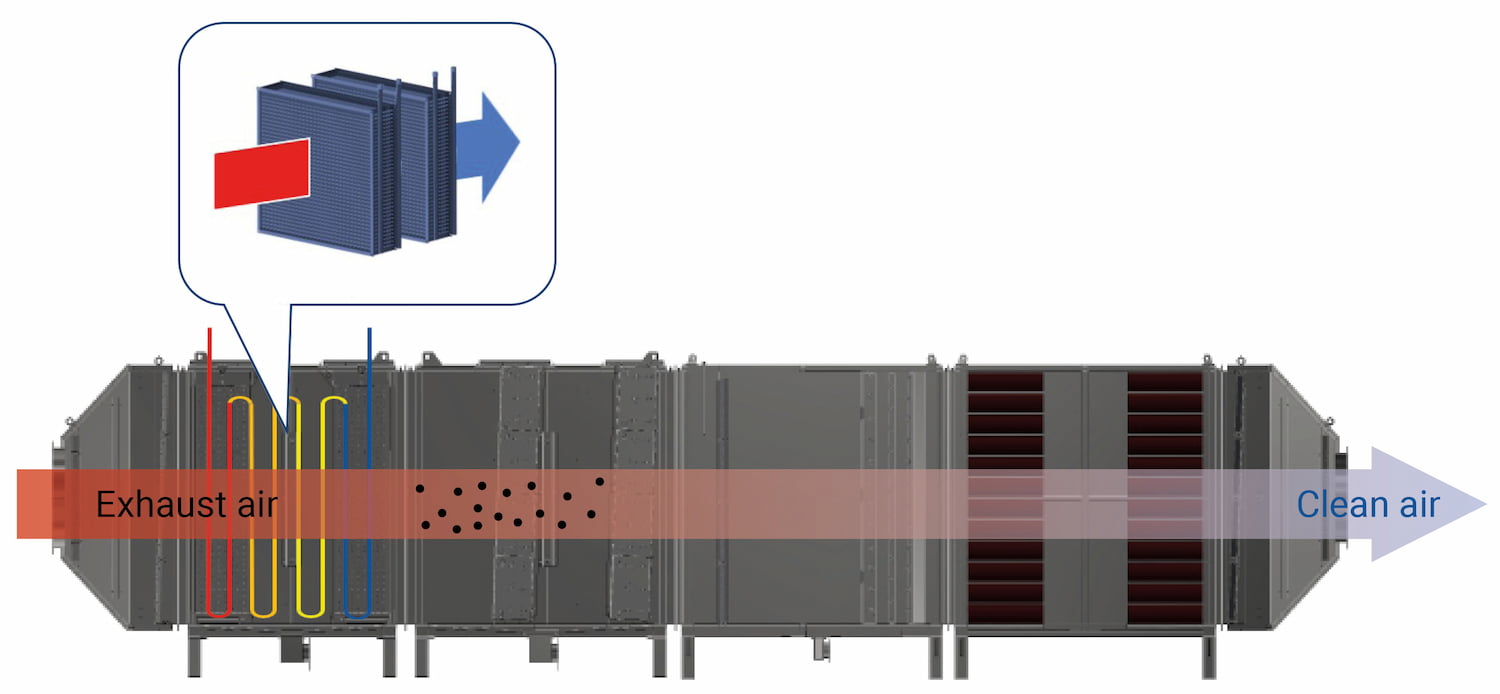
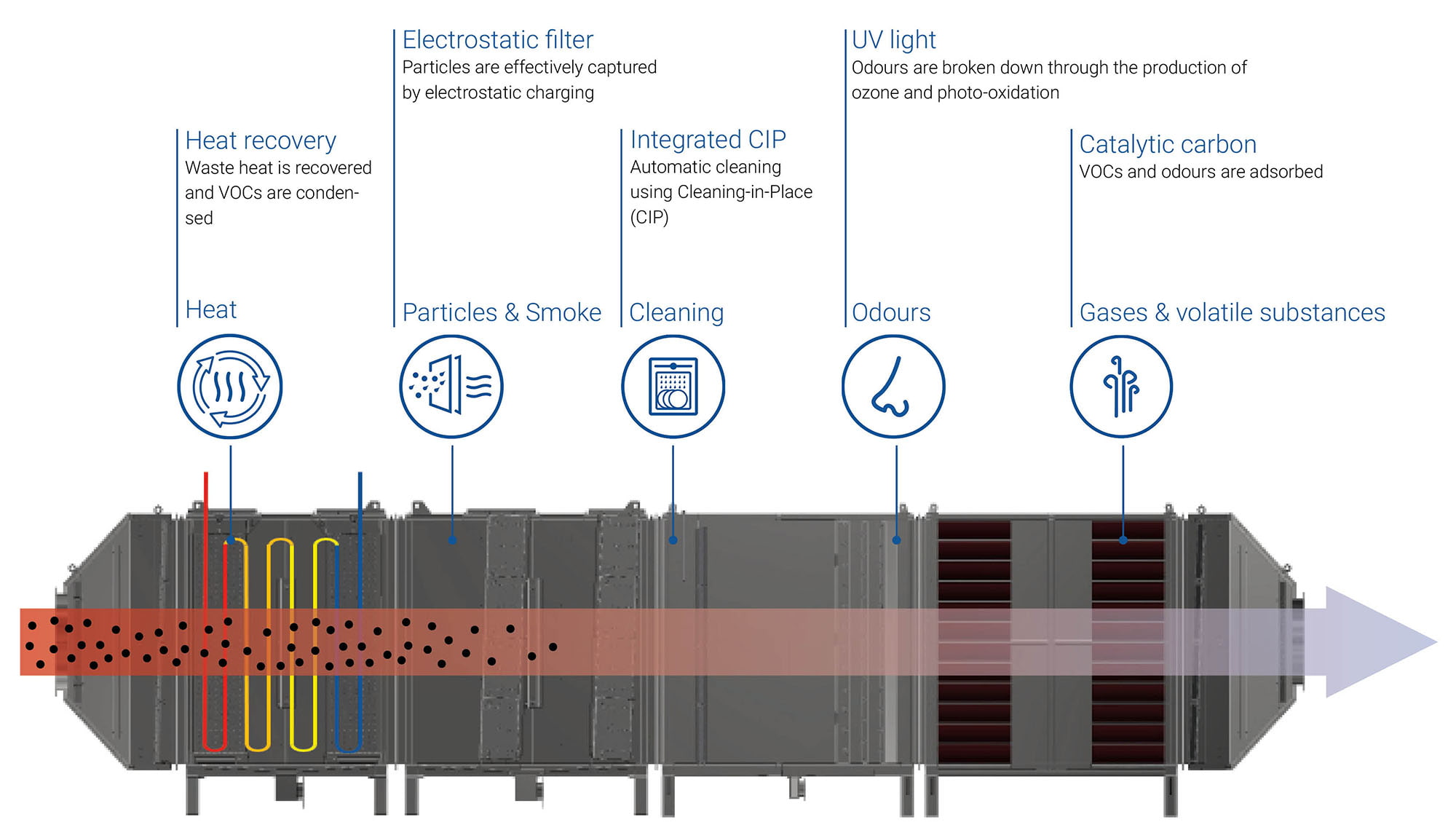
Our modular process modules can be combined in many ways and configured individually. Depending on the requirements, the ULTRAVENT® H enables the separation of particles and odours, VOC and the recuperation of heat from the exhaust air.
ULTRAVENT® H. H for horizontal.
Flexible configuration of the ULTRAVENT® H
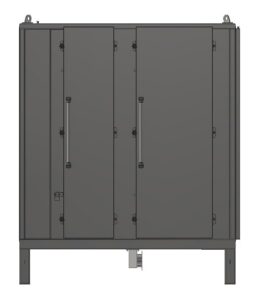
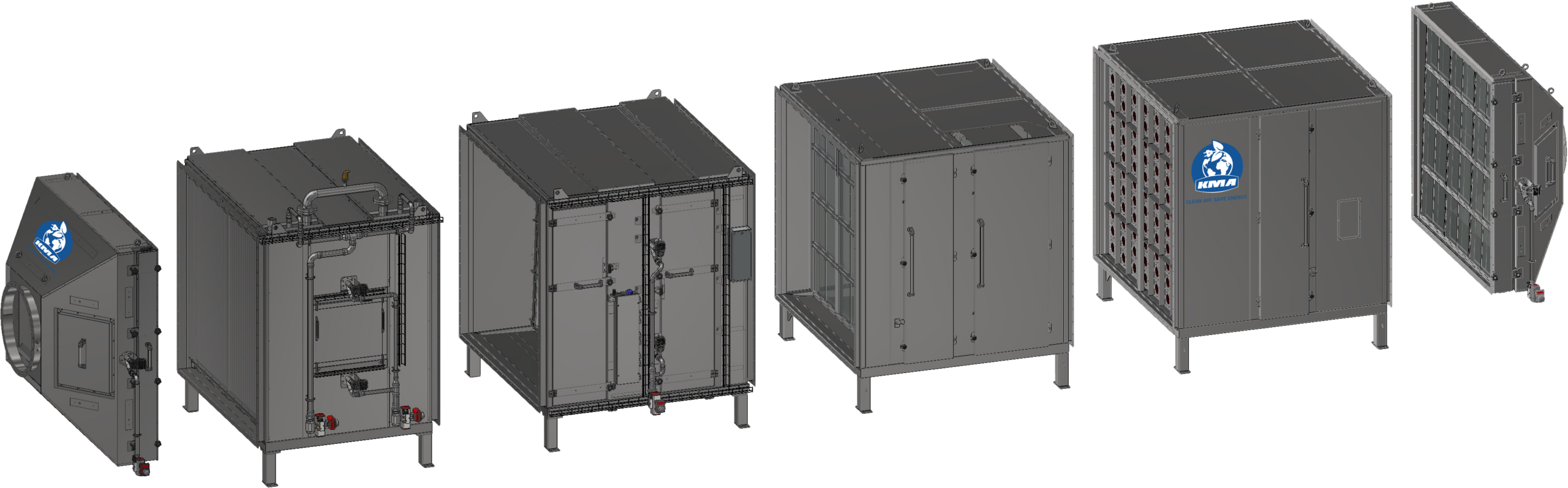
The selection of modular process stages determines the length of the ULTRAVENT® H. Thanks to its compact design, the ULTRAVENT® H measures a universal height of 2,680 mm.
Flexibly choose the process modules and equipment options that best suit your specific application and exhaust air requirements and benefit from the wide range of solutions offered by the high-performance ULTRAVENT® H filter system.
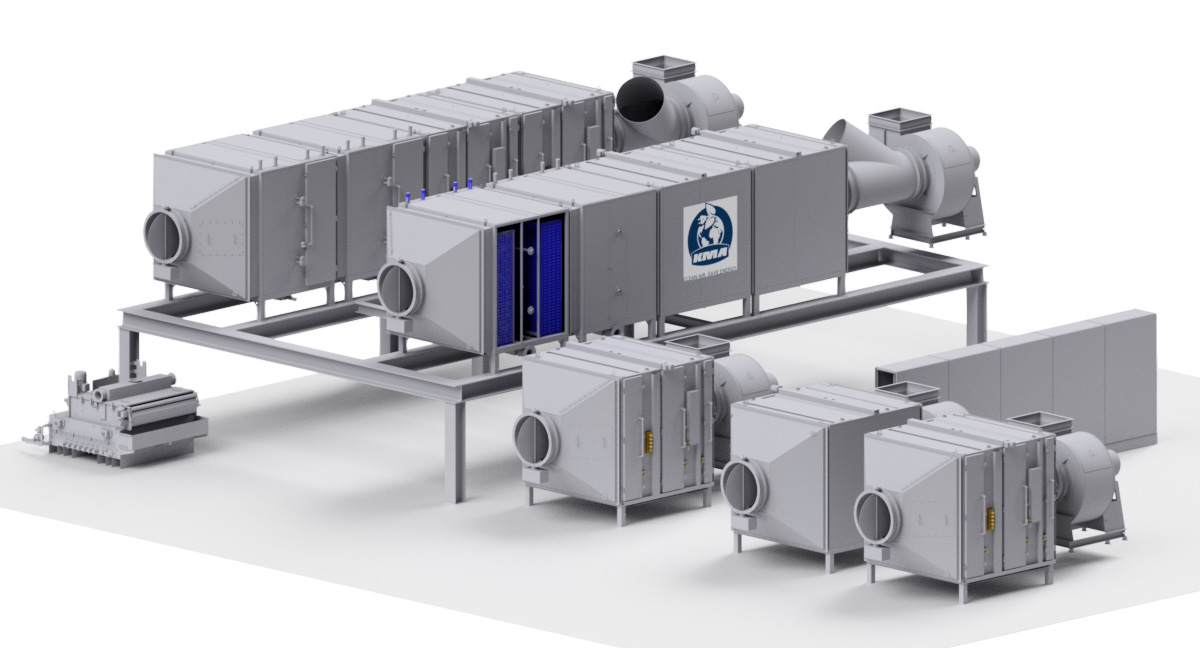
The illustrations show the ULTRAVENT® H for an exhaust air volume of 30,000 m³/h in various equipment variants.
ULTRAVENT H
with electrostatic precipitator only
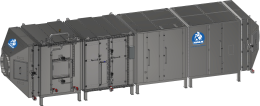
ULTRAVENT H
with many modules
ULTRAVENT H
with many modules
Sizes from 30,000 m³/h
Sizes & variants
The filter housing can be painted or supplied in a pickled stainless steel version.
The filter cells and heat exchangers can be installed in either aluminum or stainless steel versions.
Exhaust air filter capacity
The ULTRAVENT® H offers a flexible configuration in any combination and according to the desired design. The full range of process stages is offered in modules from 30,000 m³/h. The combination of several filter systems offers solutions for higher exhaust air flow rates. The length of the filter system depends on the modules used.
Technical modules of the ULTRAVENT® H
High-performance functional modules
Flexibly choose the process modules and equipment options that best suit your specific application and exhaust air requirement
and benefit from the wide range of solutions offered by the high-performance ULTRAVENT® H filter system.
Targeted recovery of process heat
Heat exchanger module
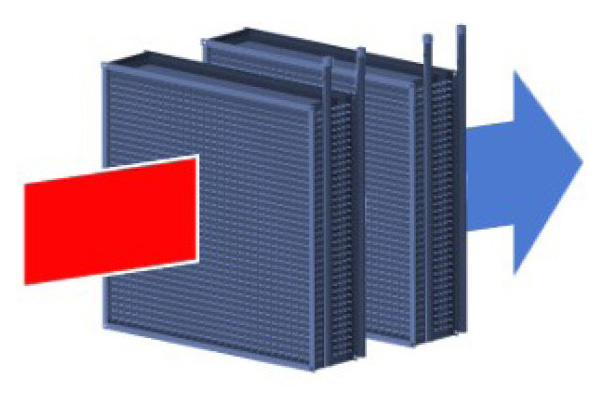
The heat exchanger of the ULTRAVENT® H uses the thermal energy contained in the exhaust air and makes it available to the process in a targeted manner. This reduces the need for conventional heating energy and noticeably lowers the total energy consumption.
Particularly in energy-intensive processes with high exhaust air temperatures, heat recovery can optimize the energy efficiency of your production plants. At lower temperature levels, the targeted use of highly efficient heat pumps increases the effectiveness of heat recovery through optimized heat transfer and higher efficiency.
How You Can Use the Recovered Heat
Air-to-water heat recovery
The ULTRAVENT® H enables the integration of high-performance heat exchangers for the effective recovery of process energy from the exhaust air as well as for cooling and condensation during exhaust air filtration. Depending on the application, the heat exchangers can be operated with water or glycol.
Highly efficient particle separation
Electrostatic precipitator module
Industrial processing creates dust, smoke, sticky and greasy emissions as well as the finest oil mist. Many of these emissions are harmful to the environment and hazardous to health.
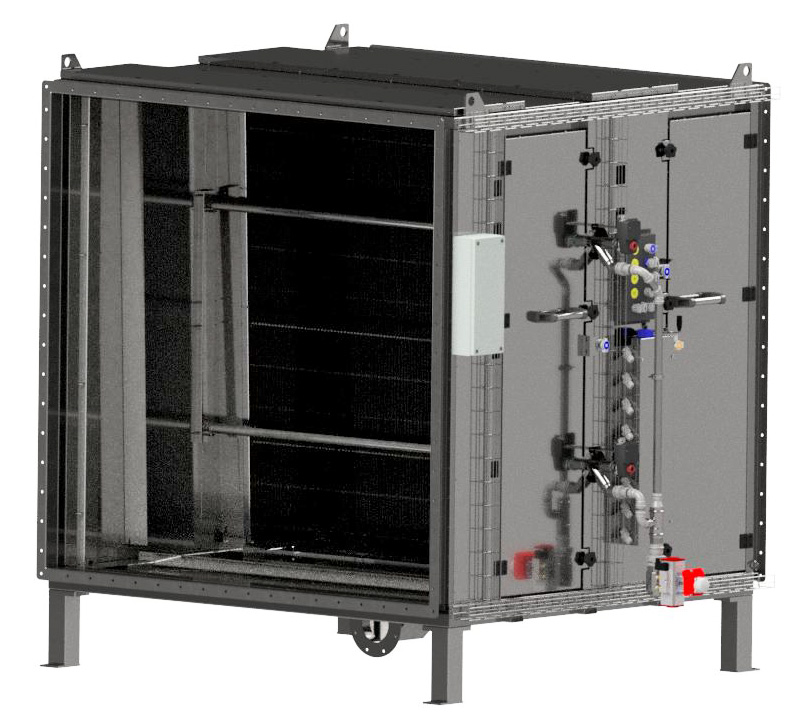
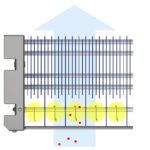
The electrostatic precipitator of the ULTRAVENT® H cleans industrial exhaust air with high efficiency. Separation is carried out electrostatically with low energy consumption. The charged particles are directed to the collector plates due to electrostatic forces.
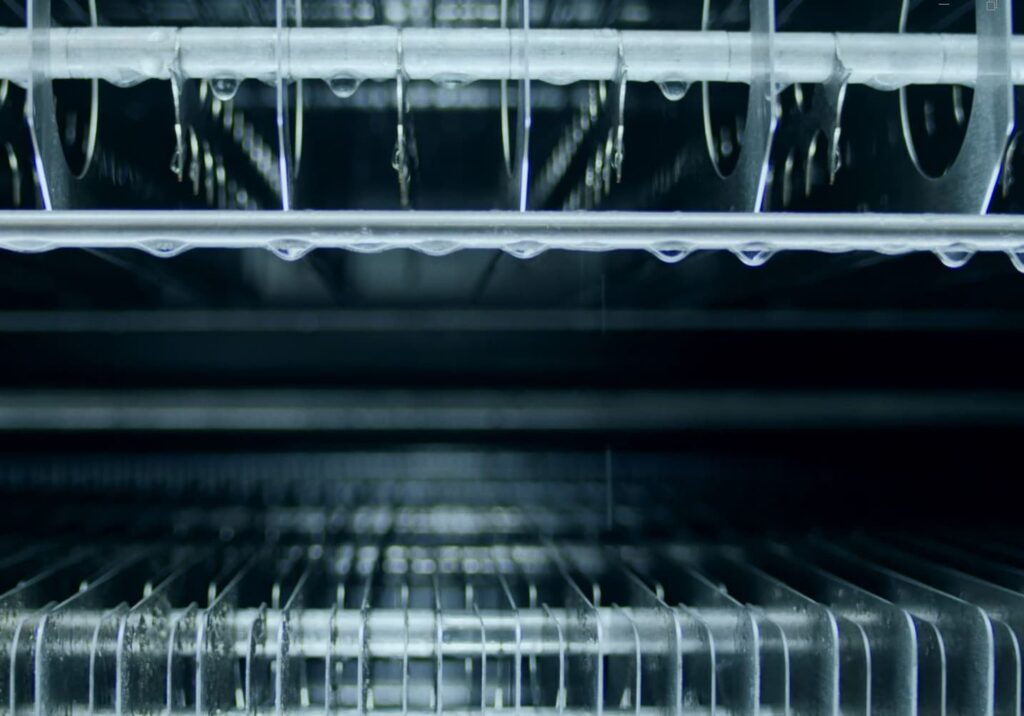
Liquid components drip off and collect in a floor tray. Sticky and viscous substances initially remain on the plates until they are effectively removed by the integrated automatic cleaning system.
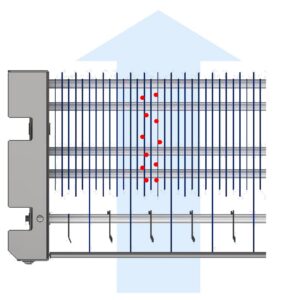
How electrostatic charging works

Ionisation
The high voltage at the ionisation profiles creates an electric field. Particles passing through are charged here.
Separation
Earthed separator plates attract the passing particles and retain them with minimal air resistance.
Cleaning system
Automatic integrated cleaning
Many of our customers have already had experience with cleaning electrostatic precipitator cells and heat exchangers. This work is dirty, tedious and time-consuming.
With automatic cleaning in place (CIP)
- the ULTRAVENT® H relieves maintenance staff,
- reduces cleaning effort to a minimum and
- protects the technology from wear.
Similar to a household dishwasher, the integrated cleaning system offers various programs to choose from. The filter cells, the heat exchanger and the UV light are cleaned automatically within the filter system, thereby minimising unwanted downtime in the production line. Developed over many years, the cleaning system delivers unique effectiveness while maintaining resource efficiency.
Modules for the removal of odours and VOC
UV light and catalytic carbon

UV light In combination with natural oxygen (O₂), UV light generates highly reactive radicals and ozone. This allows intensely smelling molecules to be oxidized and a significant improvement in the odour situation to be achieved.
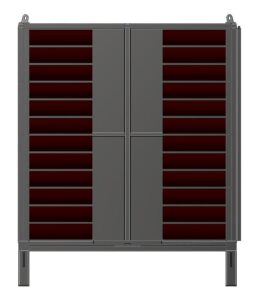
Catalytic carbon A carbon filter module is used in the ULTRAVENT H to separate entrained gases and volatile organic compounds (VOC). The integrated catalytic carbon filter with fine coke adsorbs VOC, gases and many odours highly effectively.
Energy efficiency
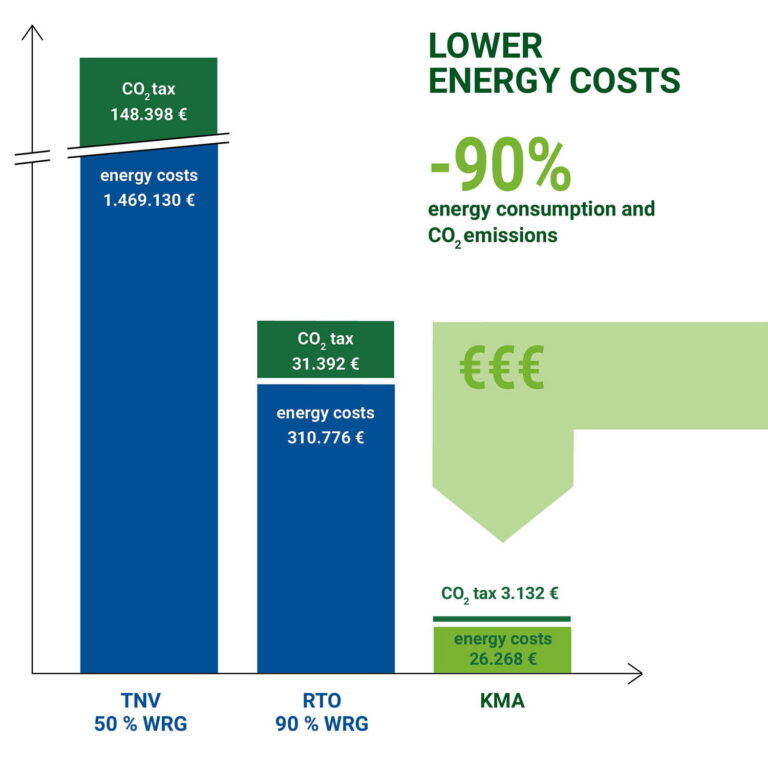
Use of environmental technology reduces operating costs
Basis of calculation
- Exhaust air flow rate: 30,000 m³/hour
- Operating time:: 5,760 hour/year
- Gas price: 9 cents/kWh
- EU-CO₂ tax: 40 €/tonne | 2024
- Practical example: metalworking industry
- Exhaust air filtration without thermal oxidation: save energy, reduce costs
The ULTRAVENT® H cleans odours and VOC without thermal oxidation – and thus significantly reduces energy consumption and operating costs. While a TNV often requires over 750 °C to meet limit values and causes fossil energy consumption as well as emissions such as CO₂ and NOₓ, the ULTRAVENT® H works without combustion and thereby improves the life cycle assessment (LCA) and cost certainty.
- Low energy consumption through electrostatic precipitator technology
Compared to mechanical filter processes, the use of the ULTRAVENT® H reduces energy requirements by more than 80%. The electrostatic precipitator is optimized for low air resistance and minimal pressure drop. The integrated cleaning system reduces maintenance effort, downtime and follow-up costs due to filter replacement and ensures long-lasting filter cells and modules. - Heat recovery from process exhaust air: permanently reduce energy costs
Through integrated heat recovery, the ULTRAVENT® H makes process waste heat usable, e.g., for production processes, and thus reduces energy consumption and operating costs. At the same time, this reduces CO₂ emissions and thus also CO₂-related costs in the long term.
Other ULTRAVENT® products
FAQ — Questions about the ULTRAVENT® H
How does the ULTRAVENT® H differ from the ULTRAVENT® M?
Both systems are based on the same modular system consisting of heat exchanger, electrostatic precipitator, odour and VOC stages as well as an integrated cleaning system — the difference lies in the design and the exhaust air flow rate for which they are designed. The ULTRAVENT® M has a vertical structure and covers 5,000 to 20,000 m³/h; the ULTRAVENT® H is the horizontal in-line design for exhaust air flow rates from 30,000 m³/h. In practical terms, this means: with the M, the system grows in height with each process stage, with the H in length. Which design is suitable depends not only on the volume flow rate but above all on the available space — and whether overall height or floor space is the scarcer factor.
In which industry is the ULTRAVENT® H mainly used?
Wherever large exhaust air flow rates occur — this is less a question of the industry than of the system size. In metalworking, these are foundries and die casting plants through to heat recovery at the melting furnace, often where several cells work on a central system. In food production, these are industrial frying, roasting and cooking lines whose exhaust air is combined centrally. In addition, there is plastic and rubber processing as well as drying processes. What these applications have in common is that the exhaust air is hot and highly loaded — and that the recovery of the heat contained pays off particularly clearly at this scale.
How much energy can be saved with the ULTRAVENT® H compared to conventional processes such as thermal oxidation or RTO?
Around 90% — and with these volume flow rates, this has a significant impact in absolute terms. The reason is twofold: The ULTRAVENT® H cleans odours and VOC without thermal oxidation, which often requires over 750 °C to comply with limit values and permanently burns fossil energy for this purpose. At the same time, electrostatic separation reduces electricity requirements by more than 80% compared to mechanical filter processes because there is hardly any air resistance. The comparative calculation on this page is based on 30,000 m³/h, 5,760 operating hours per year and 9 cents per kilowatt-hour of gas and compares an oxidiser with 50% and an RTO with 90% heat recovery. For your system, we will calculate the comparison using your operating data.
Why horizontal — what are the benefits of the in-line design for large volume flow rates?
Because from 30,000 m³/h, the overall height becomes the limiting factor. If the process stages were stacked on top of each other with these cross-sections, systems would be created that in many halls would be neither installable nor sensibly maintainable. Instead, the in-line design arranges the modules one after the other: the exhaust air flows through them horizontally, the overall height remains constant at 2,680 mm, and each module is accessible from the side. There is also a flow-technical advantage — the uniform horizontal flow through large cross-sections keeps the pressure drop low and the separation performance uniform over the entire filter surface.
How much space does the system need, and what determines its length?
The height is the same at 2,680 mm for all configurations; the length results from the number of process stages selected. A system with a pure electrostatic precipitator is correspondingly short, while a configuration with heat exchanger, electrostatic precipitator, carbon stage and cleaning system is longer. For exhaust air flow rates above one unit, several filter systems are combined in parallel — at Tönnies, for example, two devices with 30,000 m³/h each work side by side. This is exactly what distinguishes the ULTRAVENT® H from individually engineered custom designs: the space requirement can be determined in advance instead of only resulting from the construction.
How is a system of this size cleaned? What happens during maintenance?
Automatically and in place. For systems of this size, manual cleaning does not scale: cleaning filter cells and heat exchanger surfaces by hand would be dirty, time-consuming and associated with long downtimes. The integrated CIP cleaning system cleans both within the system, with selectable programs similar to a dishwasher, so that cleaning can be scheduled during already planned production breaks. There is no need to change filter media at all. Where several filter systems work in parallel, one unit can also be maintained while the others continue to run — production does not have to stop for this.
Are there references of this magnitude?
Yes, and not only in metalworking. In food production, Tönnies has been cleaning the exhaust air from nine deep fryers and cooking ovens at the Rheda-Wiedenbrück site since 2020 with two parallel-connected filter units of 30,000 m³/h each and integrated heat recovery; the case is documented in the trade journal Fleischwirtschaft. The technology has also been in use at Rügenwalder for years. In rubber processing, a central system at Kraiburg Elastik cleans 60,000 m³/h of production exhaust air and heats the hall at the same time. In die casting, the range extends to sites where several units working in parallel clean several hundred thousand cubic metres per hour together. We would be happy to put you in touch with a reference site.
What exhaust air temperatures can the ULTRAVENT® H handle?
The ULTRAVENT® H is designed for processes with high exhaust air temperatures up to 200 °C and can also be combined with heat recovery there. The heat exchanger cools the exhaust air before the filter stages and makes the energy contained usable; at lower temperature levels, a highly efficient heat pump increases the usable portion. In addition to the temperature, the loading of the exhaust air and the question of which heat sinks are available at the site are decisive for the design.
How can we help?
WE FIND THE RIGHT CONTACT PERSON
Just let us know briefly what it’s about. Our sales team will be happy to take your enquiry and forward it to the expert for your field.
We put our trust in KMA