Exhaust Air Filtration
&
Heat Recovery
in Textile Finishing
Clean oil-laden stenter exhaust air and recover its heat – in one system. Meet your emission limits and cut your energy costs.
The Green Edge for Your Textile Finishing
Your stenter frame is one of your biggest energy consumers. And it sends valuable heat out through the stack, unused.
Textile finishing runs at high temperatures. That takes a lot of energy. It also produces hot exhaust air full of oil and fibers, and this air must meet strict emission limits.
This is where your opportunity lies. You have to clean this exhaust air anyway. It also carries heat that you can recover and reuse.
Conventional exhaust air treatment wastes this heat. KMA cleans the exhaust air and recovers the heat in one system. That is your green competitive advantage.

COMPLY WITH EMISSION LIMIT VALUES
The ULTRAVENT® electrostatic precipitator achieves a separation efficiency of up to 99.8% and reliably retains oil, aerosols, and fibers – pure air quality below 10 mg/m³ is achievable. This ensures you meet limit values permanently and safely.

Use energy smartly.
Cut costs noticeably.
Heat from the exhaust air is used to warm fresh air and water. In one of our projects, a textile finisher saves 2.3 million kWh a year. That equals about 18% of the energy costs at the stenter frame. Cleaning is automatic and takes place during operation.

ACHIEVE ESG GOALS.
CUT CARBON FOOTPRINT.
Less fossil energy means measurably less CO₂. At one textile finisher, emissions fell by about 0.11 kg of CO₂ per running metre of fabric. Customer data from continuous production confirms the actual savings.

YOUR APPLICATION in Textile Finishing
Processes for Which We Provide Solutions
“The investment has paid off. The KMA solution is a modular complete package that… combines air/air and air/water exchange in one device. It uses the heat exchanger surface more efficiently and is more compact than comparable products…”
Fernando Saraiva, Textile Expert, Tech4Food
We put our trust in KMA


WE HAVE THE SOLUTION for Your Stenter Frame
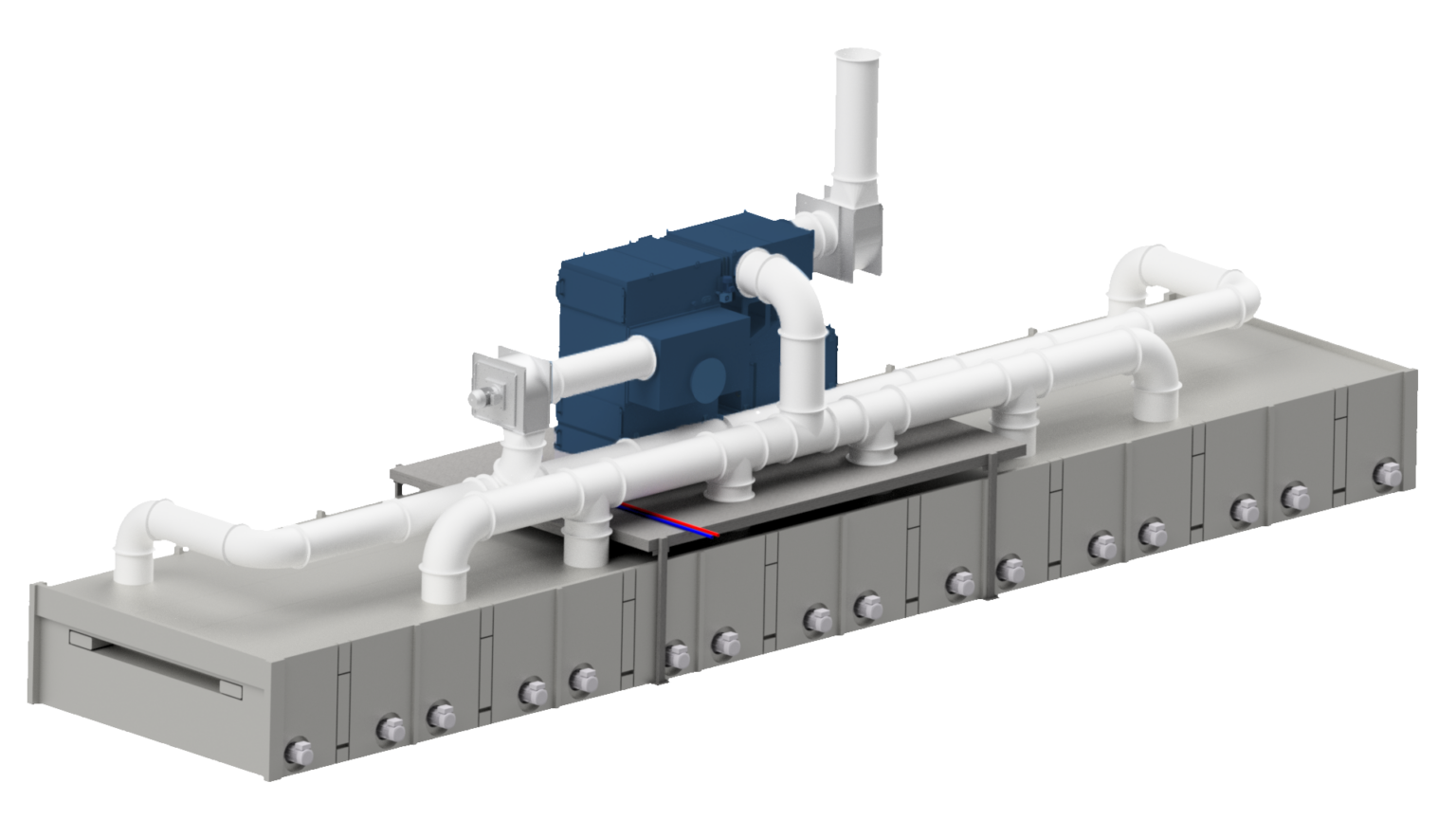
Heat Recovery and Exhaust Air Filtration in One System
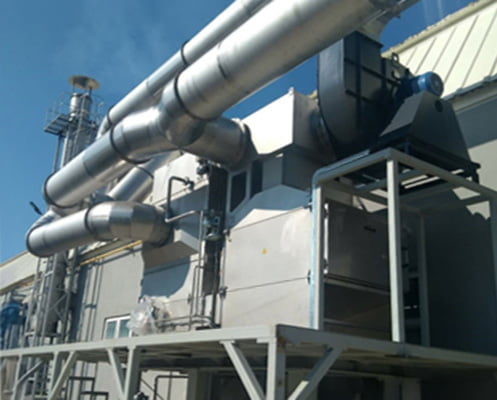
The ULTRAVENT® T combines heat exchanger and electrostatic precipitator as a tandem into an integrated solution for stenter frames and other high-temperature processes. The system ensures reliable exhaust air filtration with an electrostatic precipitator (ESP), sustainably reduces energy costs, and specifically recovers valuable process heat. Thanks to the tandem design, a later ESP retrofit remains possible.
Functional Principle & Heat Utilization
Two Components Combine Energy Recovery and Emission Reduction
Exhaust air from stenter frames is heavily contaminated with oily, greasy, or pasty particles and simultaneously contains valuable waste heat from the finishing process. The ULTRAVENT® T combines high-performance heat exchangers with highly effective electrostatic precipitators – for particularly economical use of waste heat and reliable separation of emissions.
How You Can Use the Recovered Heat
heat recovery
• Reduces CO2 emissions directly in the production line
• Supports more sustainable textile finishing and a lower CO2 footprint for the end product
• Improves the energy efficiency of the stenter frame
• Can be used for heating buildings, storage areas, etc.
• Reduces energy demand in hot water generation
Air-to-Air and Air-to-Water
• Additionally provides preheated water for downstream processes
• Enables particularly flexible use of recovered heat
• Priorities and target temperatures can be set according to demand
• Offers high potential savings through maximum utilization of available waste heat
How You Benefit from KMA: One System. All Advantages.

High-Performance Filtration
Highly effective electrostatic precipitator.
Separation efficiency of up to 99,8 %

Combined Heat Recovery
Air-to-Air and/or Air-to-Water in one system

Automatic Cleaning
Constant performance without manual maintenance effort

ESP Retrofit
Modularly retrofittable, even
on existing systems
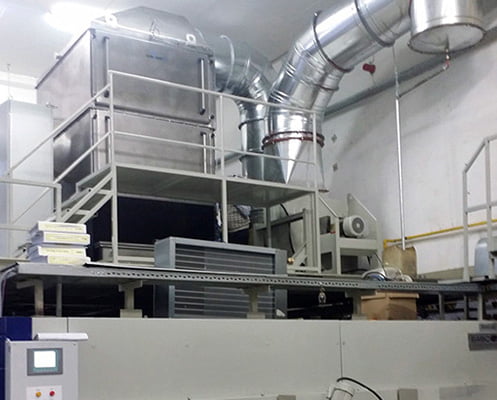
At the Mönchengladbach site, two stenter frames generate around 24,500 m³/h of exhaust air at 140 to 143 °C. This is hot, energy-rich, and simultaneously heavily contaminated with oil, aerosols, and fiber particles. A central KMA ULTRAVENT® tandem filters this exhaust air and recovers the heat. Part of the heat is used for the process water of the upstream washing machines, while the other part is returned to the stenter frames as preheated fresh air. The result is 2.345 million kWh in energy savings and around 500 t less CO₂ per year.
How AUNDE Turns Stenter Exhaust Air into an Energy Source
INDUSTRY BEST PRACTICE: 500 t less CO₂ per year
How our customers benefit

Kirayteks
Hot, heavily oil-laden exhaust air (avg. 180 °C) was generated at six stenter frames. KMA recovers heat from this to warm process water and simultaneously separates 35–50 liters of process oil per day, which can be reused. Kirayteks thus saves around €300 daily with an amortization period of less than two years.
Freudenberg Performance Materials
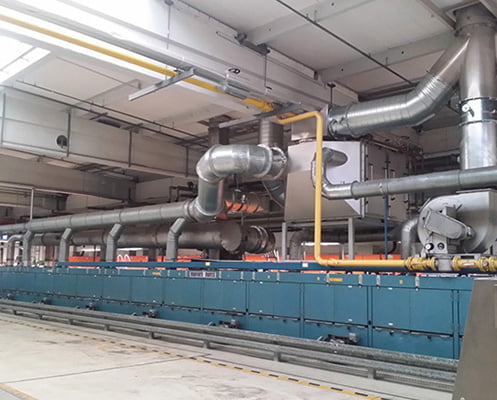
Freudenberg wanted to utilize heat from stenter exhaust air while reliably complying with emission limit values. KMA combined the existing ULTRAVENT® 15,000 with a new ULTRAVENT® 20,000 – the recovered heat raises the supply air from 10 to 100 °C, and the electrostatic precipitator keeps the pure air below 10 mg/m³.
PAŞA Tekstil
Paşa Tekstil utilizes waste heat from its stenter frame twice: a single KMA system transfers heat to both the supply air (28 → 115 °C) and the dyeing water (22 → 74 °C). This dual heat transfer extracts the maximum from the available waste heat.

- 600 t CO₂
less per year
- 270 t CO₂
less per year
- 523 t CO₂
less per year
>35-50 l
Process oil per day
>10 mg/m³
Pure air
22 → 74 °C
Water heating
>~ €300
Savings per day
10 → 100 °C
Supply air heating
28 → 115 °C
Supply air heating
Frequently Asked Questions about Exhaust Air Filtration and Heat Recovery in Textile Finishing
Does the solution fit my stenter frame — does KMA work with all manufacturers?
Yes, the ULTRAVENT® T works independently of the manufacturer – this means it can be operated on machines from Brückner, Monforts, Krantz, Babcock, or Ilma as well as on older frames for which the machine manufacturer no longer offers heat recovery. This is the practical difference compared to a solution integrated into the frame: the latter is tied to the respective model and cannot be transferred to every existing frame. In mixed machine parks, the recovered warm supply air can also supply several stenter frames simultaneously. Simply send us the manufacturer and year of manufacture of your frames — we can quickly see what is possible.
At what exhaust air temperature and how many operating hours does heat recovery on a stenter frame pay off?
Stenter frames operate at temperatures up to 200 °C depending on the finishing process and type of fabric; the exhaust air leaves the process accordingly between about 120 and 180 °C. In this range, recovery practically always pays off — but it is not the temperature alone that is decisive, but its interaction with volume flow rate, operating hours, and energy price. The calculation itself is simple: recovered power in kilowatts, multiplied by operating hours and energy price. Give us these four values, and we will determine the achievable recovery performance for your stenter frame.
Can I start with just heat recovery?
Yes. The ULTRAVENT® Tandem consists of two functional modules — heat recovery and electrostatic separation — which can also be installed individually. If only one module is built initially, the tandem design is prepared so that the second can be added later without modification. In practice, this means: those who meet their limit values today and primarily want to reduce energy costs start with heat recovery and retrofit the ESP modules as soon as requirements increase. It works the same way in reverse — if you need to solve an emission problem first, you add heat recovery later. It is only important to register the second stage from the start so that space, statics, and connections are provided for it.
How much preheated supply air can be returned to the stenter frame — and how hot?
As a rule of thumb, around 30% of the exhaust air volume can be returned to the stenter frame in the form of preheated supply air — it usually doesn’t take more because its fresh air requirement is limited. The temperature is high: at Paşa Tekstil, the fresh air is brought from around 28 °C to about 115 °C and fed directly into the stenter frame via a pipeline — only a few degrees below the required operating temperature. At AUNDE, the air/air heat exchanger heats 5,913 m³/h of outside air from 29.5 °C to 129 °C; there, 10 to 20% of the energy flows into the supply air because the larger part goes into the process water of the upstream washing machines. How high the share is for you depends on the fresh air requirement of your stenter frame and which other heat sinks are available at the site.
Air-to-air, air-to-water, or both — what fits my operation?
The ULTRAVENT® Tandem can be implemented in three configurations: only with air/air heat exchanger, only with air/water heat exchanger, or as a combination of both. Air/air heats the stenter supply air and directly reduces gas consumption; air/water generates hot water for washing, dyeing, and subsequent processes. The combination typically delivers the highest energy yield because it cools the exhaust air in two stages and serves both sinks simultaneously. The right configuration depends on the heat demand at your site.
Don't the heat exchangers get oily and clogged?
This is the classic objection from textile finishing — and the reason why many companies have already had bad experiences with heat recovery on stenter frames. The ULTRAVENT® Tandem has an integrated CIP cleaning system for this: at AUNDE, the heat exchanger surfaces are cleaned every 60 minutes during operation without interrupting production; a more comprehensive cleaning of all modules follows during batch changes or production stops. This ensures that heat transfer remains permanently at the design level instead of dropping over the months.
What happens to lint and wax particles?
They are separated in stages. A lint filter in the inlet hood retains coarse fiber particles before the exhaust air reaches the heat exchangers. Oil and wax aerosols condense during cooling and are subsequently separated in the electrostatic precipitator; the liquid portion drips from the collector plates into a storage tank, while firmer deposits are washed off by the cleaning system. Exactly this sequence — first lint, then heat, then fine separation — keeps the downstream stages clean.
Does the smoke plume above the chimney disappear?
Yes. The visible plume consists mainly of oil and aerosol droplets from the finishing process; if they are separated in the electrostatic precipitator, it reliably disappears. At AUNDE, the cleaned air exits at around 60 °C because the heat was previously extracted from it. Visible water vapor can still occur physically in cold weather; it is not an emission in terms of limit values.
What happens if my emission limit values become stricter later?
The system can be retrofitted. The ULTRAVENT® Tandem consists of two functional modules — heat recovery and electrostatic separation — which can also be installed individually; if only one component is built initially, the tandem design can be prepared so that the second is added seamlessly later. A company that primarily wants to reduce energy costs today therefore starts with heat recovery and adds ESP modules as soon as stricter limit values apply.
Can this be retrofitted to an existing stenter frame, or only for new systems?
Yes, retrofitting in existing facilities is actually the norm. The ULTRAVENT® Tandem is connected to the existing exhaust air line of the stenter frame; nothing is changed on the machine itself, its control system, or the fabric guidance. At AUNDE, two stenter frames that had been running for years were retrofitted. Essentially three things need to be planned: the installation area — thanks to the compact design, often directly above the stenter frame, alternatively next to it or outdoors —, the ducting for the preheated supply air back to the machine, and the connection to the hot water consumer. The connection work is scheduled during an already planned downtime. We can clarify what is possible for you on-site based on your actual plant situation.
Your direct contact
Talk to Viktor Schön
Do you operate stenter frames in the textile finishing industry and need to get odours, exhaust air plumes or emission levels under control? Or would you like to reduce energy losses and CO₂ emissions?
We’ll then work with you to determine which solution is best suited to your process.
Our Solutions in the Trade Press
Publications & Articles
clean air.
save energy.
>3,000
Systems installed worldwide
80 %
Energy savings possible compared to conventional exhaust air technology
360°
Emissions, exhaust air and energy. Engineered together.
1,500 +
Customers worldwide trust our technology
More Information
Downloads & Links
Laws & guidelines
TA-Luft: Clean Air Maintenance – Emission Limit
VDI 2262-3: Air Quality at the Workplace – Clean Air Recirculation
TRGS 900: Occupational Exposure Limits