Stenter frame heat recovery:
Exhaust air as an energy source
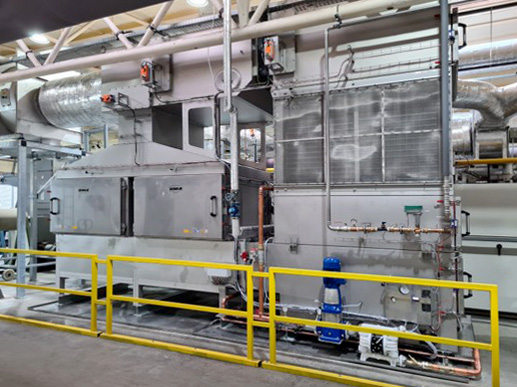
With the KMA ULTRAVENT® tandem, AUNDE uses the waste heat from two stenter frames, heats process water for upstream washing machines, and saves 2.345 million kWh of energy per year—while exhaust air is cleaned at the same time.
Clean stenter exhaust air and recover 2.345 million kWh of energy per year—like AUNDE
At the textile company AUNDE, two stenter frames are not only a source of polluted exhaust air, but also a source of usable process energy. A central KMA heat recovery system recovers heat from around 24,500 m³/h of exhaust air, heats process water for the dyeing process, and returns the remaining energy to the stenter frames as preheated air.
Result: lower gas consumption, cleaner exhaust air, and a significantly improved carbon footprint.

- 2.3 million kWh less
energy demand per year
The recovered heat is used directly in the process—for two stenter frames and upstream washing processes.

- 500 tonnes less CO₂ emissions per year
AUNDE reduces fossil energy use and improves the site’s carbon footprint.

Exhaust air filtration and heat recovery in one system
Electrostatic precipitator, air/water heat exchanger, air/air preheating, and automatic CIP cleaning.
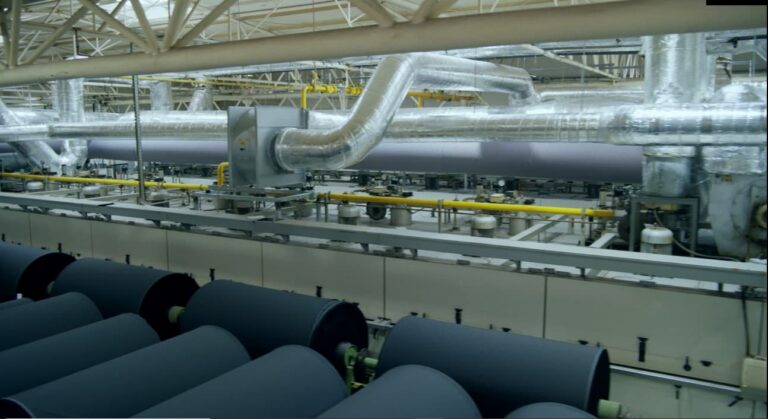
Textile finishing on stenter frames is inherently energy-intensive. Depending on the process, operating temperatures can reach up to 200°C, and energy costs account for a significant share of ongoing production costs. At the same time, the exhaust air is heavily contaminated—among other things with oil smoke, aerosols, fibre and wax particles. Operators are therefore under double pressure: reliably comply with emission limit values and use energy more efficiently at the same time.
For two stenter frames at the AUNDE site in Mönchengladbach, a solution was to be implemented that combines exhaust air filtration and heat recovery. Together, the stenter frames generate around 24,500 m³/h of exhaust air at about 140 to 143°C—ideal conditions to make the thermal energy it contains directly usable again in the process.
High energy demand,
polluted exhaust air, and rising pressure to act
The starting situation at Aunde in textile finishing
Top 3 pain points at AUNDE

Control emissions reliably
Oil, fibre and other particles in stenter exhaust air must be reliably separated to comply with legal requirements and site specifications.
Avoid energy losses from
exhaust air
Hot exhaust air carries away
valuable process energy lost – in case of AUNDE 520.598 € gas costs p. a. (for the stenter frames) – even though it could be used directly elsewhere.
High CO2 emissions
Textile finishing is to become more sustainable. High energy consumption directly impacts the CO₂ footprint of exhaust air filtration.
The potential on the stenter frame
Polluted exhaust air becomes usable process energy
The biggest lever is to think exhaust air filtration and heat recovery together.
This is exactly where KMA comes in: the ULTRAVENT® tandem can make heat usable as preheated supply air, as hot water, or in combination.
This allows the available energy to be utilised far better than with systems that only return hot air to the stenter frame:
At AUNDE, the recovered energy was to be used entirely within the process. Part of the heat warms water for upstream washing machines; another part is returned to the stenter frames as preheated fresh air.
- Air/air: preheated supply air back into the stenter frame
- Air/water: hot water for washing, dyeing or downstream processes
- Combination: maximum energy yield from a compact system
“The recovered energy can be reused 100% internally in the process, in the same place and at the same time. This saves us 2,345,000 kWh of energy every year, so the system pays for itself in a very short time.”
Andreas Matzat, AUNDE MG Finishing and Environmental Protection
Enormous Cost and CO₂ Reduction
Aunde’s results
€93,800/year calculated energy cost savings at €0.04/kWh gas
100% of the recovered energy usable within the process
500 t less CO₂ emissions per year
2.345 million kWh energy savings per year
With the system, AUNDE saves around 2.345 million kWh of energy per year. According to AUNDE, CO₂ emissions fall by approx. 500 t per year; depending on the calculation basis, KMA puts the case at around 469 t or over 400 t. The heat recovery is used entirely within the process—at the same place and at the same time.
KMA installed a central ULTRAVENT® tandem with integrated heat recovery and electrostatic precipitator. The recovered energy is used in two ways: first, water for two upstream washing machines is heated. Second, part of the energy is returned to the stenter frames as preheated fresh air. At the same time, the electrostatic precipitator removes condensed aerosols and particles from the exhaust air.
Published in The Textile Magazine—the leading trade magazine in the textile industry
The trade publication: How we successfully supported AUNDE
Retrofittable and investment-secure
The system can be designed flexibly for different stenter frame manufacturers and can be seamlessly expanded with ESP modules if requirements or limit values change.
Automatic CIP cleaning
Heat exchangers and the electrostatic precipitator are cleaned automatically. This keeps heat transfer consistently high and significantly reduces manual maintenance effort.
High-grade exhaust air filtration with ESP
The integrated electrostatic separator removes smoke, aerosols as well as oily, greasy and pasty particles efficiently and with long service life.
Double heat recovery in one system
Air/air and air/water heat exchangers can be combined in one system. This makes energy usable where it has the greatest leverage in the plant.
The KMA system combines electrostatic separation with two-stage heat utilisation: an air/water heat exchanger heats process water from 16°C to 72°C, while an air/air heat exchanger preheats fresh air and returns it to the stenter frame.
Our solution for stenter frames: KMA ULTRAVENT® tandem
Our solution for energy-efficient textile finishing
Use stenter exhaust air as an energy source
Stenter exhaust air is not only an emissions issue, but also an energy source.
KMA combines exhaust air filtration and heat recovery in one robust system for real textile conditions.
clean air.
save energy.
>>3,000
Systems installed worldwide
80 %
Energy savings possible compared to conventional exhaust air technology
360°
Emissions, exhaust air and energy. Engineered together.
1,500 +
Customers worldwide trust our technology
Do you have questions?
Frequently asked questions about waste heat utilisation on the stenter frame
Can AUNDE’s results be transferred to my operation?
Yes—provided the basic conditions are similar, and they usually are in textile finishing. At AUNDE it’s around 140°C at 24,500 m³/h from two stenter frames; at Paşa Tekstil in Turkey it’s an average of 129°C at 20,000 m³/h; both systems pay off. What determines the yield is the interplay of temperature, volume flow rate, operating hours and energy price—and the question of which heat sinks the site offers. At AUNDE, these were two upstream washing machines and the stenter frame supply air, which is why 100% of the energy could be used within the process.
Why isn’t it enough to simply return the hot exhaust air to the stenter frame?
Because a stenter frame can only take in a limited amount of fresh air. Systems that exclusively return preheated air are therefore capped by the machine’s fresh-air demand: even in the best case, only around 30% of the recovered energy goes this route; the rest would remain unused. At AUNDE, 10 to 20% of the energy flows back into the supply air, while 276 kW via the water heat exchanger heats 8.5 m³/h of process water from 16°C to 72°C. Only the combination fully utilises the available energy: at AUNDE, 100% of the recovered energy is used within the process, in the same place and at the same time.
Doesn’t the system’s power consumption eat up the savings?
No—the ratio is clear. At AUNDE, the entire KMA system consumes 150,000 kWh of electricity per year and recovers 2,345,000 kWh of energy—about fifteen times as much. This is possible because electrostatic separation creates hardly any air resistance; the power draw of the filter cells is below 1.25 kW. Mechanical filters, by contrast, have to overcome a high pressure drop—and that is exactly where the electricity consumption arises with conventional technology.
How is the recovered energy distributed at AUNDE?
Of the 469 kW recovery output, 276 kW goes into the air/water heat exchanger: it heats 8.5 m³/h of water from 16°C to 72°C and supplies two upstream washing machines—without any input of electricity or gas. The remaining share—around 10 to 20% of the energy—goes back into the stenter frames as preheated fresh air: 5,913 m³/h of outside air is heated from 29.5°C to 129°C. Over the year, this adds up to 2.345 million kWh, which is used entirely within the process—in the same place and at the same time.
How often is cleaning done—and does production stop for it?
No—production continues. At AUNDE, the integrated CIP system cleans the heat exchanger surfaces every 60 minutes during operation, without interrupting production. During batch changeovers or an already planned production stop, a more comprehensive cleaning of all modules follows. This exact rhythm is the reason why heat transfer remains permanently at design level instead of dropping over the months—with oil-laden stenter exhaust air, that is the decisive difference.
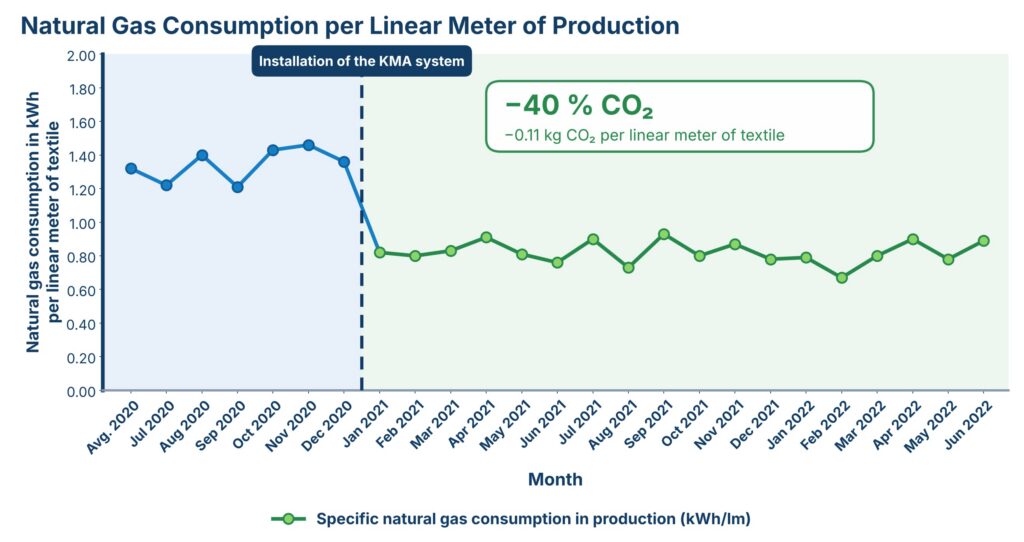
How does this affect the CO₂ balance per metre of goods?
At AUNDE, energy consumption per running metre of textile drops by around 40% according to the company, which corresponds to about 0.11 kg CO₂ per running metre. Over the year, that’s around 469 tonnes less CO₂; AUNDE itself cites about 500 tonnes. For textile finishers, the per-metre KPI is particularly relevant because brand customers increasingly request emissions at product level and incorporate them into their own reporting—a value that can be improved directly and verifiably with heat recovery.
Your direct contact
Talk to Viktor Schön
Do you operate stenter frames in the textile finishing industry and need to get odours, exhaust air plumes or emission levels under control? Or would you like to reduce energy losses and CO₂ emissions?
We’ll then work with you to determine which solution is best suited to your process.
The ULTRAVENT® T saves energy and costs
Our customers’ business cases prove it:
Our solutions in the trade press
Publications & technical articles
More information
Downloads & links
Laws & guidelines
TA-Luft: Air pollution control – emission limit
VDI 2262-3: Workplace air quality – pure-air recirculation
TRGS 900: Workplace limit values