
KMA ULTRAVENT® III
The electrostatic precipitator for industrial exhaust air
The standard specification for die casting and metal processing: third-generation electrostatic precipitator, up to 99% particle separation, up to 85% less energy – over 3,000 systems in use worldwide.
The benchmark for high-performance exhaust air filtration
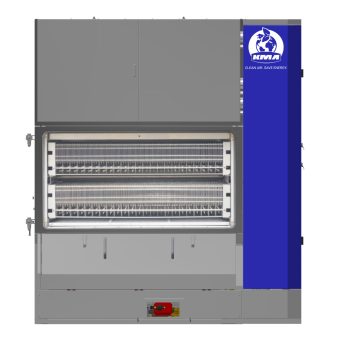
The ULTRAVENT® III is a high-performance system for industrial exhaust air filtration, designed for demanding processes with minimal energy consumption. A strong standard specification makes the system an exhaust air professional. The CIP cleaning system increases maintenance convenience, while low energy consumption reduces operating costs.

High-performance
filtration

High
Energy efficiency

Integrated
cleaning

Strong
standard specification
HOW IT WORKS
Minimal energy consumption. Maximum particle separation.
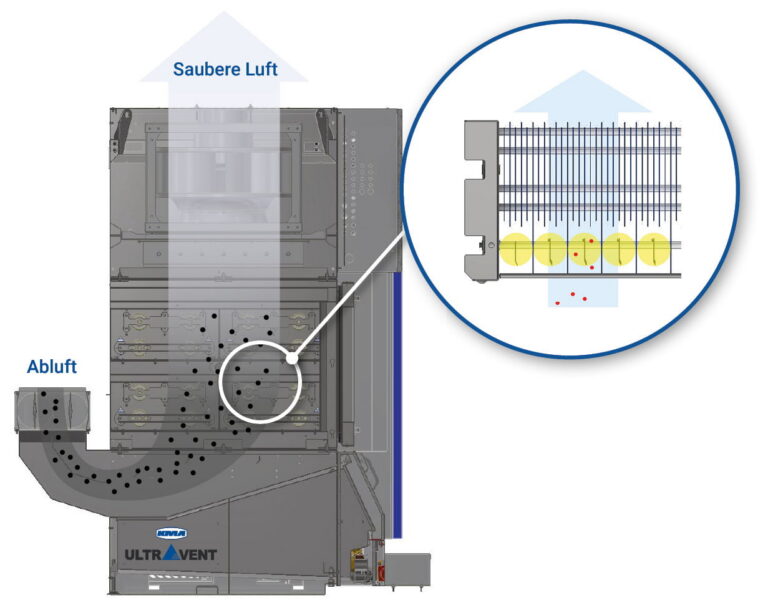
The product design of the ULTRAVENT® III is geared towards minimal energy consumption combined with maximum particle separation of up to 99%. In addition to separating smoke and dust, the electrostatic precipitator is also optimised for the separation of liquid or highly viscous substances as well as the finest oil and mould-release agent mist. The special design allows the process exhaust air to flow through with minimal resistance and effective particle and aerosol separation at the same time.
Electrostatic precipitators
are the most efficient solution
Minimal energy consumption 1.1 - 4.2 kW
> 80% energy savings in operation compared to mechanical filters
Constant performance & durability
No clogging of filter media, no pressure drop due to aerosol residues, no wear
(Automatic) cleaning instead of filter replacement
The integrated automatic cleaning system ensures technical performance and minimises maintenance effort.
Highly efficient particle separation
High-performance electrostatic precipitator
Industrial processing creates dust, smoke, sticky and greasy emissions as well as the finest oil mist. Many of these emissions are harmful to the environment and hazardous to health.
The electrostatic precipitator of the ULTRAVENT® III filters industrial exhaust air with high efficiency. Separation is carried out electrostatically with low energy consumption. The charged particles are directed to the collector plates due to electrostatic forces.
Liquid components drip off and collect in a floor tray. Sticky and viscous substances initially remain on the plates until they are effectively removed by the integrated automatic cleaning system.
How electrostatic charging works

Ionisation
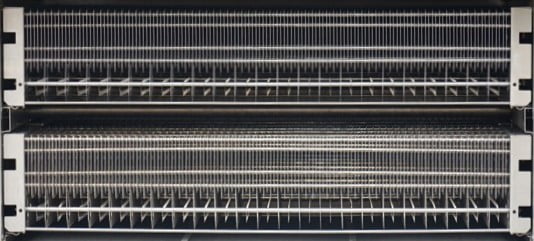
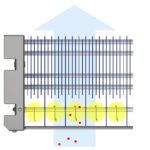
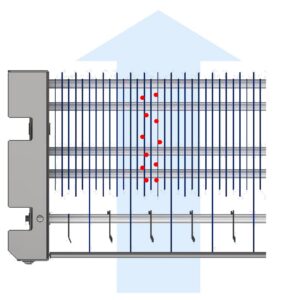
The high voltage at the ionisation profiles creates an electric field. The passing particles are charged here.
Separation
Earthed separator plates attract the passing particles and hold them back with minimal air resistance.
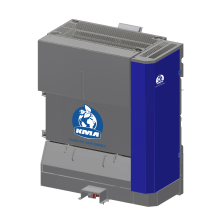
Cleaning system
Automatic integrated cleaning
Many of our customers already have experience cleaning electrostatic precipitator cells and heat exchangers. This work is dirty, laborious and time-consuming.
With automatic cleaning in place (Cleaning in Place “CIP”)
- the ULTRAVENT® III relieves maintenance staff,
- reduces cleaning effort to a minimum, and
- protects the technology from wear.
Similar to a household dishwasher, the integrated cleaning system offers various programmes to choose from. The filter cells, the heat exchanger and the UV light are cleaned automatically within the filter system, thereby minimising unwanted downtime in the production line. Developed over many years, the cleaning system delivers unique effectiveness while maintaining resource efficiency.
You are currently viewing a placeholder content from YouTube. To access the actual content, click the button below. Please note that doing so will share data with third-party providers.
More Informationcompact in every size
Sizes & variants
The ULTRAVENT® III is available in various sizes and is designed according to the exhaust air volume and application.
The ULTRAVENT® III is available in the following sizes: ULTRAVENT® III 2000, ULTRAVENT® III 5000, ULTRAVENT® III 8000, ULTRAVENT® III 10000, ULTRAVENT® III 15000, ULTRAVENT® III 20000
Suitable for your application
Equipment variants
Depending on the application and the required air purity level,
ULTRAVENT® offers various filter solutions. KMA consultants will be happy to support you in choosing the right solution and configuration for your filter system.
Single electrostatic precipitator (Type DE): Double demister, single-stage electrostatic precipitator
Recommended for exhaust air mode or, with low raw gas concentration, also for recirculation air mode
Double electrostatic precipitator (Type EE): Double demister, double electrostatic precipitator
Suitable for recirculation air mode according to VDI guideline 2262 Part 3
Optional: Increased filter effectiveness for additional particle and aerosol separation
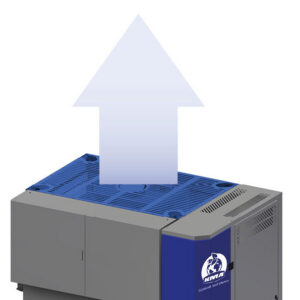
Recirculation. Exhaust air. Or with flexible switchover.
ULTRAVENT® filter systems are characterised by high energy efficiency in all designs. The filtered air is returned to the production hall in recirculation air mode or discharged outside in exhaust air mode. KMA also offers the option of switching flexibly between the two options as required (e.g. summer/winter).

Recirculation air mode
The cleaned air remains in the hall
In recirculation air mode, the filtered exhaust air returns to the workspace. This largely avoids long ductwork, energy-intensive exhaust fans and high heat losses in the winter months.
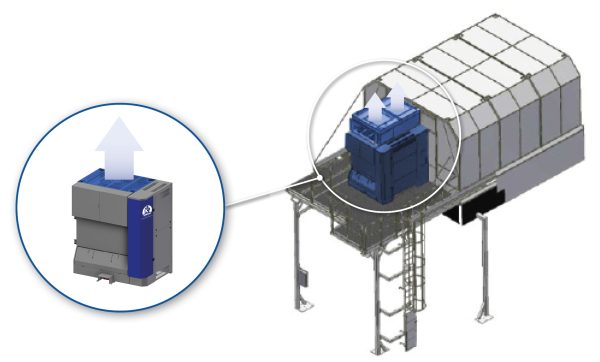
Exhaust air mode
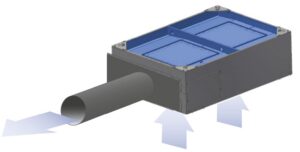
The cleaned air is guided outside via a ductwork system
In exhaust air mode, the filtered exhaust air goes outside and is replaced by fresh air. The flexible air duct is connected at the front.
Recirculation/exhaust air switchover
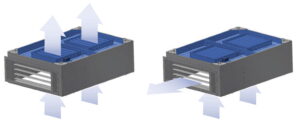
The ULTRAVENT® III can optionally be equipped with dampers to operate it alternately in recirculation or exhaust air mode.
The air duct is connected at the front. The automatic dampers can be used to switch between exhaust air mode (e.g. in summer) and recirculation air mode (e.g. in winter).
The exhaust air expert for foundries.
Maximum efficiency & best in class
The strongest standard specification in the industry
Over 3,000 systems in use worldwide
You are currently viewing a placeholder content from YouTube. To access the actual content, click the button below. Please note that doing so will share data with third-party providers.
More InformationThe energy-saving KMA ULTRAVENT® exhaust air filter system
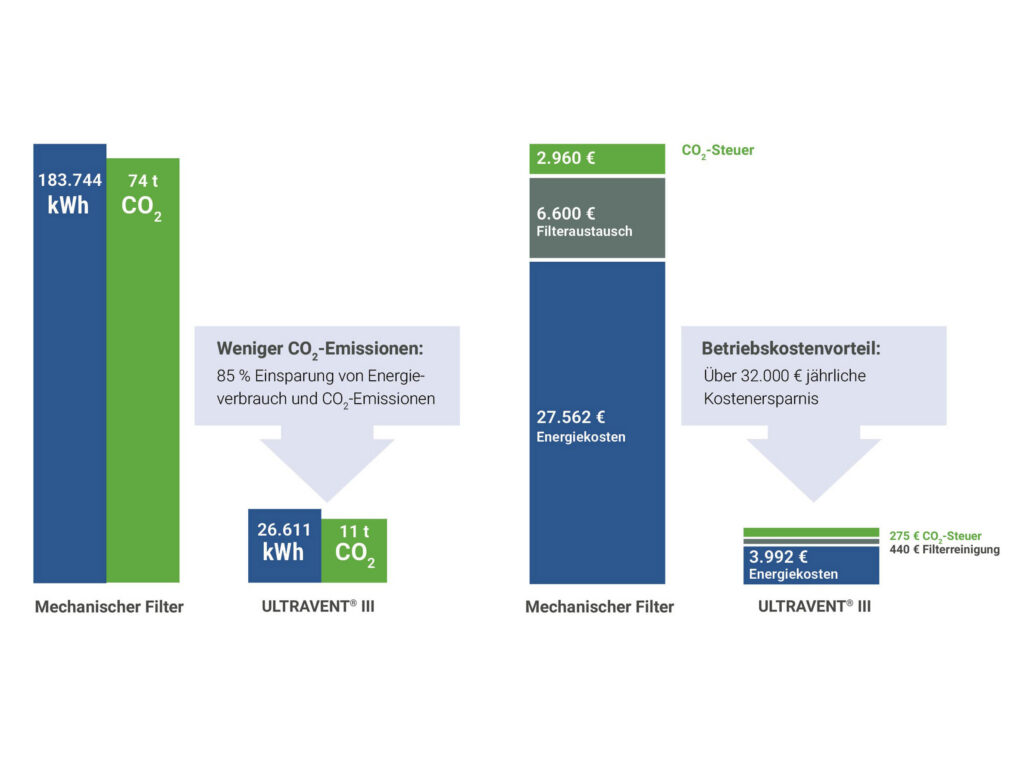
Energy efficiency
Use of environmental technology reduces operating costs
Basis of calculation
- Exhaust air flow rate: 20,000 m³/hour
- Operating time: 6,336 hours/year
- Gas price: 15 cents/kWh
- CO₂ equivalent: 401 g/kWh
- CO₂ tax: 40 €/tonne | 2024
Minimal energy consumption
Compared to a mechanical filtration process, using the ULTRAVENT® III saves over 80% energy.- Efficient operation—electrostatic precipitator
The ULTRAVENT® III electrostatic precipitator operates with particularly high energy efficiency and, depending on exhaust air output, requires between 1.1 and 4.2 kW.
- Flexible speed control with ECO+ technology
ULTRAVENT® III systems come with ECO+ technology as standard. This flexibly adjusts fan output depending on exhaust air volume. Dynamic speed control enables additional savings of up to 40%. - Low air resistance
Thanks to its intelligent design, the electrostatic precipitator is optimised for low air resistance and minimal pressure drop. - Cleaning instead of filter replacement
The integrated automatic cleaning system (CIP) makes the electrostatic precipitator durable and sustainable. This reduces operating costs and the ecological footprint by cutting waste. - Thin demister
Our stainless steel mesh separators are as thin as possible and serve only as support for the electrostatic precipitator.
DGS Druckguss Systeme has reduced its own carbon footprint by more than 90% within six years and has committed to its main customers to manufacture CO₂-neutrally from 2039. A central lever is the exhaust air technology: the new KMA Ultravent III filter systems consume over 40% less energy than their predecessors and 70 to 80 percent less than conventional fabric filters. The article shows how the Swiss die caster is transferring these standards from St. Gallen to its plants in the Czech Republic and China.
This business case proves it
The ULTRAVENT® III saves energy and costs
We put our trust in KMA


FAQ — Questions about the ULTRAVENT® III
What distinguishes the ULTRAVENT® III technically from other electrostatic precipitators?
Many filters work electrostatically — the difference lies in the design. The ULTRAVENT® III is usually equipped with two stages of filter cells, which are supplied directly by several high-voltage generators. This increases separation performance and operational reliability compared to systems with only one filter cell stage or with high-voltage contacting from one filter cell to another. Ionisation takes place via durable stainless steel profiles with ceramic insulators instead of ionisation wires that need to be replaced regularly. The automatic cleaning reaches all areas including the insulators via rotating spray bars; the demisters are also specifically adapted to this cleaning. These points determine the separation efficiency, energy consumption and service life.
How do I notice this difference in operation?
Mainly in three places: the electricity bill, the maintenance effort and time. The ULTRAVENT® III maintains 95% particle separation at less than 1 mg/m³ pure air in die casting, is approved for recirculation air mode according to VDI 2262 Part 3 and requires 1.1 to 4.2 kW depending on the size. It cleans itself automatically without components being removed — filter media replacement is completely eliminated. Added to this is a level of equipment that is not a matter of course in this device class: control from the Siemens PLC S7 family with touch panel, air-conditioned control cabinet and safety functions with overtemperature shutdown and electronically monitored maintenance door — in the PRO variant supplemented by Ethernet/Profinet connection to the cell control system, operating data history and optional remote maintenance access. This is proven by over 3,000 systems worldwide, some of which have been in operation for 25 to 35 years.
Is the ULTRAVENT® III available in different equipment variants?
Yes, it is available in the CORE and PRO equipment variants. Both are based on the same technology standard and differ exclusively in automation and convenience. CORE brings the complete filter, fan and cleaning technology with Siemens control, 4-inch touch panel, adjustable fan frequency and adjustable cleaning programme — the right choice where a solid, easily operated system is sufficient; available for sizes 8000 to 20000. PRO supplements this with connection to your cell or production control system via Ethernet and Profinet, a 7-inch panel, an extensive sensor package with operating data history and message archive, automatic fan control via differential pressure and the Eco+ interface, separate short and main cleaning programmes, automatic insulator cleaning and optional remote maintenance access; PRO is available for all sizes. Important for selection: the separation performance is the same in both variants.
What does "third generation" mean specifically?
Compared to its predecessor, the ULTRAVENT® III consumes over 40% less energy and works significantly quieter, typically under 70 dB(A). The extraction performance adapts to actual demand and can be synchronised with the spray cycle of the die casting machine, which further reduces consumption. The automatic cleaning has been accelerated and supplemented by an optional intermediate cleaning programme so that it fits better into the production schedule. And the operating parameters are monitored electronically, making maintenance predictable. For you, the result counts: the same task with noticeably less energy, less noise and less effort in operation.
How much do I really save compared to a fabric or cartridge filter?
Around 84 to 86% of the electricity consumption. The difference occurs at the fan: mechanical filters line up several stages with increasing fineness, whose air resistance must be permanently overcome — and this increases further as soon as the media become clogged with oily exhaust air. Specifically: at 10,000 m³/h, a mechanical filter system requires around 14.5 kW, the ULTRAVENT® III 2.4 kW; at 20,000 m³/h, it is 29 kW versus 4.2 kW. With 5,000 operating hours and €0.20/kWh, this corresponds to annual energy cost savings of about €12,100 or €24,800. In addition, no filter media need to be procured, changed and disposed of.
How can I tell when comparing quotes whether two electrostatic precipitators are really comparable?
On five points that are rarely in the data sheet. Firstly, the separation efficiency with a reference value: 95% at less than 1 mg/m³ pure air is different from a percentage value without specifying volume flow rate and residual content. Secondly, the number of filter cell stages — one stage separates less than two. Thirdly, the actual power consumption in kilowatts at your volume flow rate, not the connected load. Fourthly, the cleaning system: are all areas including the insulators reached, or is it only sprayed from above? Fifthly, the standard scope — what is included, what costs extra, and which parts are wear parts that must be regularly repurchased. Ask for these five points with every quote; the answers vary.
Recirculation, exhaust air or switchover — what is right for my hall?
This is decided by the heat requirement of your hall. In recirculation air mode, the cleaned air remains in the workspace; long ductwork, energy-intensive exhaust fans and heat losses in winter are largely eliminated. The prerequisite is a sufficiently high pure air quality — the ULTRAVENT® III is approved for recirculation air mode according to VDI 2262 Part 3 and usually achieves 95% particle separation at less than 1 mg/m³ in die casting, with the option of increased filter efficiency up to 97% at less than 0.5 mg/m³. In exhaust air mode, the cleaned air is guided outside. Both can be combined: via automatic dampers, you switch between exhaust air mode in summer and recirculation air mode in winter.
How long does the filter last, and does the separation performance decrease over time?
The electrostatic filter cells are not consumables, but durable components — a regular replacement of filter media is completely eliminated. In practice, KMA systems have been in use for 25 to 35 years; KMA has been working in the die casting industry for over 60 years, so the experience values extend over several generations of systems. The separation performance remains constant as long as the cells are clean — this is exactly what the automatic cleaning system ensures. Unlike mechanical filters, the pressure drop does not increase either because no medium can clog.
What is ECO+, and what are the benefits?
ECO+ is the standard interface to the die casting machine, via which the fan adapts its speed to the spray cycle. Extraction at full power only takes place when mould-release agent mist is actually produced; in the other cycle phases, the fan runs throttled. With the ULTRAVENT® III 20000, fan consumption drops from 5.2 to 3.9 kW — around 25% additional savings, above what the electrostatic precipitator already saves compared to mechanical systems. Connection is via common interfaces to the die casting cell control system, such as OPC UA.
What is the ULTRAVENT® III exhaust air filter best suited for?
For oil-containing, smoke and aerosol-laden process exhaust air — especially on die casting machines where mould-release agent mist, smoke and the finest oil mist occur. It is the standard there: over 3,000 systems are in use worldwide, including at Volvo and Daihatsu. It has also proven itself in forming technology, on forging and press systems and everywhere where highly viscous or sticky substances pollute the exhaust air — exactly in the applications where mechanical filters clog. Design is based on volume flow rate, temperature and load, not on the machine brand.
What exhaust air volumes is the ULTRAVENT® III designed for?
The ULTRAVENT® III is designed for exhaust air volumes between 2,000 and 20,000 m³/h. Larger exhaust air flow rates can be filtered by combining several ULTRAVENT® III exhaust air filter systems.
How can we help?
WE FIND THE RIGHT CONTACT PERSON
Just let us know briefly what it’s about. Our sales team will be happy to take your enquiry and forward it to the expert for your field.