HEAT RECOVERY and
EXHAUST AIR FILTRATION
for melting furnaces
Make cost-effective use of process waste heat from melting-furnace exhaust air, keep emissions safely under control, and sustainably reduce energy costs.
Heat recovery pays off at the melting furnace
The hot exhaust air from every melting furnace contains valuable energy. KMA recovers this process heat and makes it usable where your operation needs it—either as a retrofit on a single furnace or as an energy source for the entire production site.
In most cases, we return the heat as hot water: for production hall heating, for washing systems and phosphating, for hot water, or for feeding into an existing heating network. Where the furnace technology allows, returning it as hot air is also possible—for example to preheat the burner supply air at the melting furnace, which reduces fuel consumption directly at the furnace. Which route pays off fastest depends on the heat demand at your site.
The second advantage: exhaust air filtration can be integrated directly. KMA systems reliably comply with the strict dust limit values of the new EU BAT conclusions for foundries. This way, you combine emissions protection and energy efficiency in one system—on a small scale as well as in megacasting.
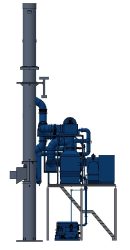
Retrofit on an existing melting furnace
Even a small foundry saves noticeably.
Example:propane-fired furnace with 1.5 t capacity in a foundry in Germany.
The furnace exhaust air at around 345°C heats 22.8 m³/h of water from 65 to 80°C, delivering just under 400 kW of heating output for the hall.
Result: 1.6 GWh of recovered heat per heating period and up to 9% less propane consumption —as a compact retrofit on the existing furnace.
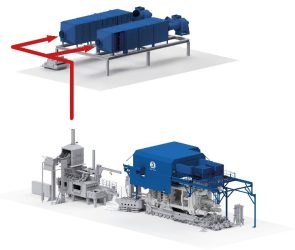
Greenfield megacasting project
Here, the energy balance of the entire site is what counts.
Example: natural-gas-fired shaft furnace with 4.5 t capacity at a European OEM.
The hot shaft-furnace exhaust air provides warm water for phosphating in the paint shop—cleaned by an integrated electrostatic precipitator, cheaper to operate than a bag filter.
Result: up to 2.8 GWh of usable heat per year, lower energy demand across the entire site —while reliably meeting emission limit values.

1.6 GWh of heat per heating period

9% less propane

Simple retrofit
on the existing furnace

Make full use of funding opportunities
2.8 GWh of heat as an energy source

Meet emission limit values

- 0.5 GWh energy consumption vs. bag filters

Low maintenance costs thanks to CIP
clean air.
save energy.
2.8 GWh or more energy yield per year
9% less propane consumption
1.6 GWh usable heating energy
Up to 0.5 GWh savings compared to bag filters
We put our trust in KMA








“With the KMA solution, we have taken the energy efficiency of the entire production site to a new level—this solution turns furnace exhaust air into an energy source for the foundry of the future.”
Klaus Hansen, foundry architect, Odin Ltd.
(Photo from left to right: Dr Holger Wagner, KMA, Klaus Hansen, Odin Ltd.)
Improved energy efficiency in the foundry
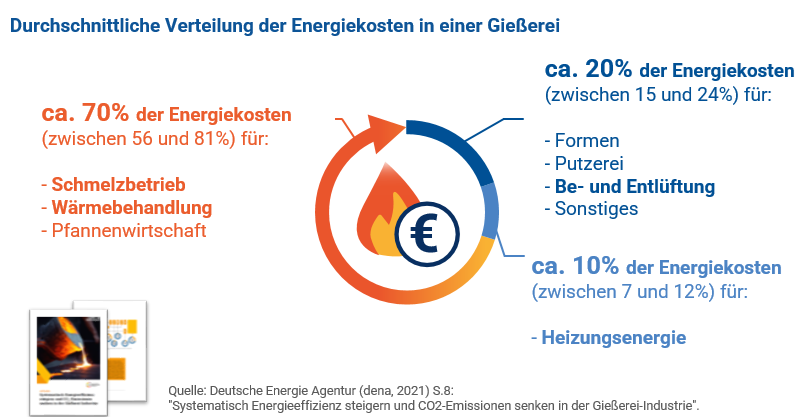
70% of your energy costs are in process heat. We recover it.
Holistic solutions in the foundry combine exhaust air filtration, heat recovery, supply air provision and energy utilisation into a coordinated overall system. Instead of merely discharging exhaust air safely, the process waste heat it contains is made technically usable for an energy-efficient production site.
OUR SOLUTION for the melting furnace in large casting
Green megacasting with improved energy efficiency
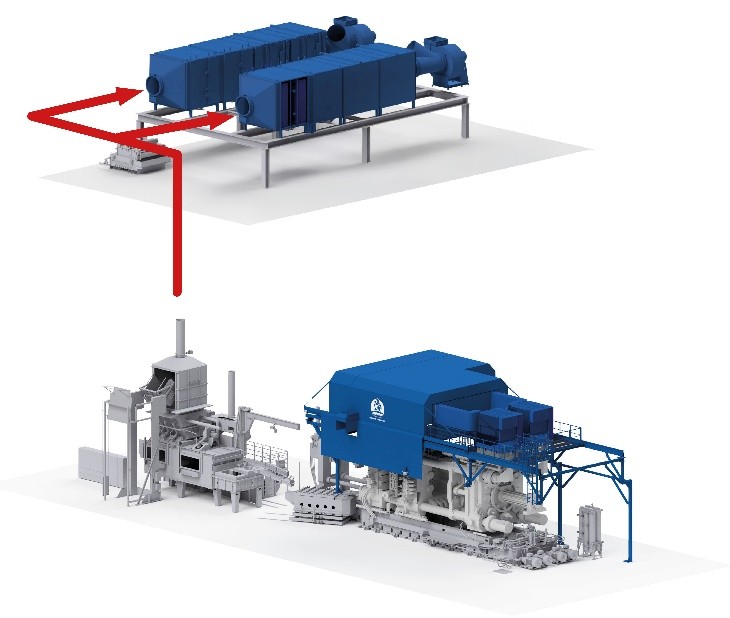
Large casting needs high-capacity melting furnaces—and anyone investing in a megacasting casting cell will usually build a new furnace as well. That’s exactly when it pays to plan the evironmental technology in from the start: capture, filtration and heat recovery can be integrated into the production hall layout instead of being added later.
Up to 2.8 GWh of usable heat per year, emissions reliably below the limits, and around 0.5 GWh less energy consumption than with bag filters.

Recover
heat
Meet the strictest EU emission limit values

Save 0.5 GWh energy consumption compared to bag filters

Reduce maintenance costs
with CIP system
Here’s where it gets specific:
Results from the customer example
- HEAT RECOVERY FOR HOT WATER from 40°C → 90°C (approx. 500 kW/h) with approx. 2.8 GWh energy yield per year, used for the paint shop, air conditioning and other processes
- MEETS STRICT EU EMISSION LIMITS with under 5 mg/m³ dust EU BAT limit value thanks to multi-stage electrostatic precipitators with high separation efficiency
- ENERGY-EFFICIENT OPERATION OF ULTRAVENT® FILTER CELLS thanks to an open design and low pressure drop, less fan power
• 0.5 GWh savings vs. bag filters - HIGH MAINTENANCE CONVENIENCE THROUGH AUTOMATIC CLEANING VIA CIP SYSTEM for cleaning the heat exchangers and filter cells, no filter replacement required
Key figures for the example application at the melting furnace
- Furnace type: shaft furnace, fired with natural gas
- Capacity: 3.5 t melting capacity, 7 t holding capacity
- Exhaust air temperature: approx. 590°C
- Exhaust air volume: approx. 3,000 Nm³/h or 9,400 m³/h at operating temperature (melting)
- Annual operation: approx. 5,000 casting hours + 3,000 additional operating hours at reduced heat
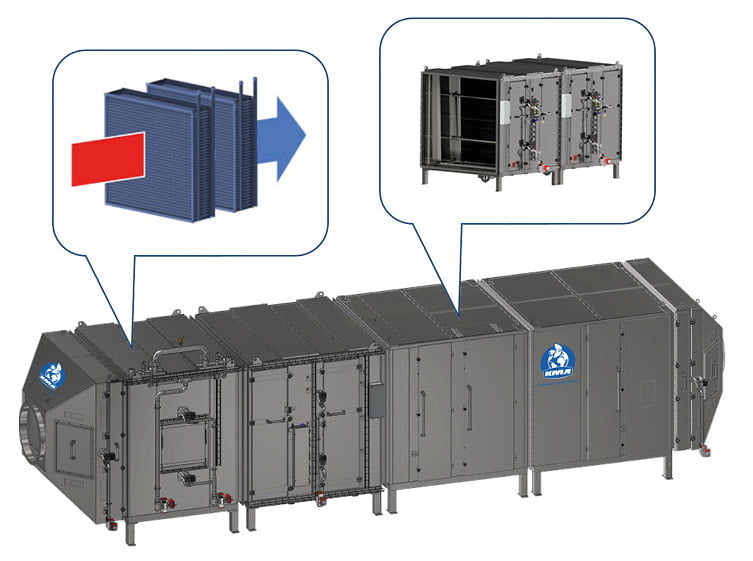
Example configuration of the KMA ULTRAVENT® H
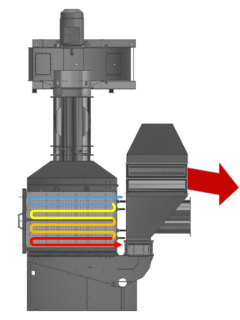
- Two modules with a total of four stages of specially developed finned-tube heat exchangers made of stainless steel
- Two modules with a total of four stages of electrostatic precipitators made of stainless steel
- Integrated CIP cleaning system (cleaning in place (CIP)) for heat exchangers and electrostatic precipitators
- Thermal insulation of the hot surface
- Dimensions: approx. 10 m (L) x 2.4 m (W) x 2.7 m (H)
The efficiency boost for your existing melting furnace
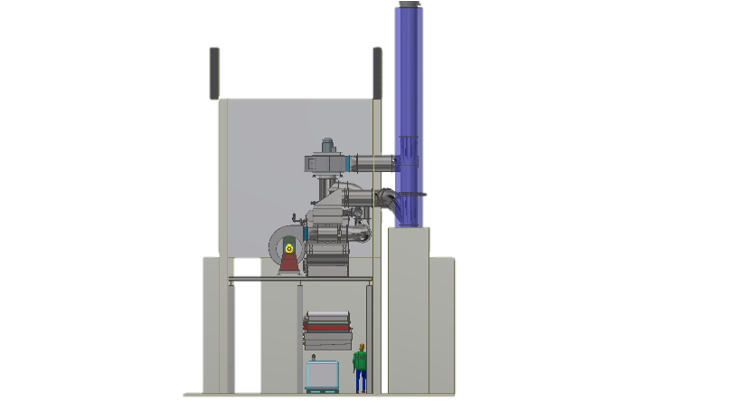
KMA Umwelttechnik offers customised solutions for the specific requirements of foundries. With various product lines for use on melting furnaces, KMA ULTRAVENT® can be precisely adapted to the required performance and on-site installation situation using individually configurable functional modules. — Reduce propane consumption by 9%, use 1.6 GWh of thermal energy, retrofit solution with funding opportunities.

Reduce propane consumption
by 9%
Benefit from 1.6 GWh of thermal energy

Use a retrofit solution for your furnace

Make full use of funding opportunities
Here’s where it gets specific:
Results from the customer example
- HEAT RECOVERY FOR HOT WATER from 65°C → 80°C (approx. 400 kW) with approx. 1.6 GWh heating energy per heating period, fed into the hot-water circuit of the building heating system
- UP TO 9% LESS PROPANE CONSUMPTION by substituting the previous building heating
- COMPACT RETROFIT ON THE EXISTING FURNACE without rebuilding the furnace system—the existing melting technology remains unchanged
- HIGH MAINTENANCE CONVENIENCE THROUGH AUTOMATIC CLEANING VIA CIP SYSTEM for cleaning the heat exchangers and filter cells, no filter replacement required
- SHORT PAYBACK TIME—in this specific case supported by funding of 25% of the investment sum
Key figures for the example application at the melting furnace
- System: propane-fired melting furnace with 1.5 t capacity
- Location: foundry in Germany
- Exhaust air temperature: approx. 345°C
- Heat transfer medium: 22.8 m³/h water, 65°C → 80°C
- Heat recovery output: approx. 400 kW
- Usable heating energy: approx. 1.6 GWh per heating period
- Energy utilisation: hot-water circuit of the building heating system
- Savings: up to 9% propane consumption
- Funding: 25% of the investment sum (Germany, 2025)
Example configuration of the KMA ULTRAVENT® M
- ULTRAVENT® M with vertical airflow, capacity up to 20,000 m³/h per unit
- Multi-stage electrostatic precipitator cells for dust separation with low pressure drop
- Air-to-water heat exchanger, connected to the hot-water circuit of the building heating system
- Integrated CIP cleaning module for filter cells and heat exchangers
- Emission measurement at the stack for project-specific verification of limit values
Use melting-furnace exhaust air. Improve energy efficiency.
Your melting-furnace exhaust air is our potential.
The energy in your furnace exhaust air is always the same—what differs is its destination. Whether it goes back into the furnace, supplies a neighbouring process, heats the hall or generates electricity depends on where your site needs energy. These routes have proven themselves in foundries:
Supply neighbouring production processes
Washing systems, phosphating, drying, painting: wherever heat is already generated on site, furnace waste heat replaces natural gas or electricity.
Preheat burner air at the melting furnace
The shortest route: preheated combustion air reduces gas consumption directly at the furnace. Possible where the furnace technology allows it.
Feed into a district heating network
Where a network is nearby, surplus heat becomes yield instead of loss.
Generate cooling: absorption cooling
Absorption chillers turn heat into cooling—so the energy is also used outside the heating period.
Generate electricity: ORC system
An Organic Rankine Cycle converts process heat into electrical energy. Interesting at high exhaust air temperatures and year-round constant furnace operation.
Different ways of using heat
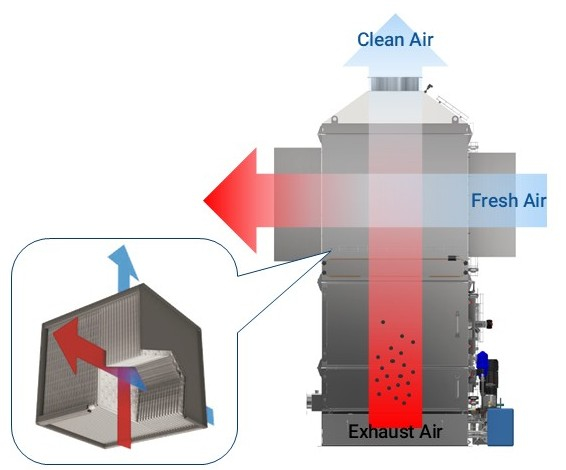
Air-to-air heat recovery
ULTRAVENT® M enables the integration of high-performance air-to-air heat exchangers for effective recovery of process energy from the exhaust air to heat the fresh air.
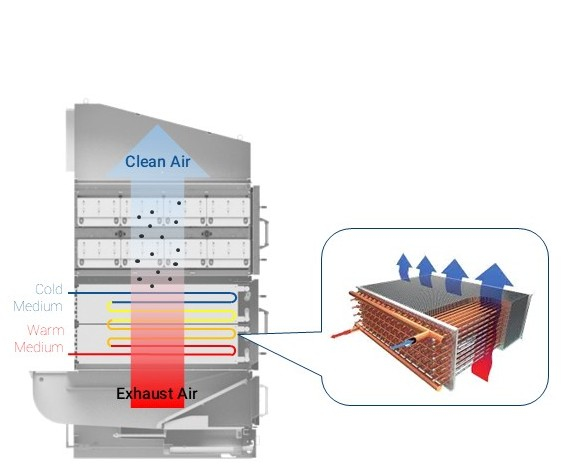
Air-to-water heat recovery
ULTRAVENT® M enables the integration of high-performance heat exchangers for effective recovery of process energy from the exhaust air as well as for cooling and condensation as part of exhaust air filtration. Depending on the application, the heat exchangers can be operated with water or glycol.
Unique cleaning of all filter functional modules
Integrated cleaning module
Many of our customers already have experience cleaning electrostatic precipitator cells and heat exchangers. This work is dirty, laborious and time-consuming.
With automatic cleaning in place (CIP) (Cleaning in Place “CIP”)
- our exhaust air filter system relieves the maintenance staff,
- reduces the cleaning effort to a minimum and
- protects the technology from wear.
Similar to a household dishwasher, the integrated cleaning system offers various programmes to choose from. The filter cells and heat exchangers are cleaned automatically within the filter system, minimising unwanted interruption time for the production system. Developed over many years, the cleaning system achieves unique effectiveness while ensuring resource efficiency.
You are currently viewing a placeholder content from YouTube. To access the actual content, click the button below. Please note that doing so will share data with third-party providers.
More InformationA technical article explains why melting and casting are among the biggest energy consumers in foundries and why heat recovery from melting-furnace exhaust air is considered key to greater energy efficiency. The article highlights technical requirements, utilisation options and the need for integrated concepts.
The next step towards a climate-neutral foundry
Best practice: GIESSEREI reports (Issue 05/2021)
FAQ — Do you have questions?
Frequently asked questions about heat recovery at the melting furnace
Can heat recovery be retrofitted on existing melting furnaces?
Yes—heat recovery is retrofittable as a compact retrofit solution on virtually any existing melting furnace; KMA handles the individual design. Key parameters are exhaust gas temperature, volume flow rate and the furnace fuel. Practical example: On a propane-fired 1.5 t furnace in NRW, the exhaust air at around 345°C preheats the burner air—resulting in 1.6 GWh of recovered heat per year and 9% less propane consumption. Tell us the furnace type and fuel—we’ll check the retrofit potential.
Why is heat recovery particularly worthwhile at the melting furnace?
Because that’s where the foundry’s greatest single potential lies: melting accounts for the lion’s share of the roughly 70% of energy costs from process heat, and at up to 590°C the furnace exhaust air is the hottest heat source on site. The higher the temperature and runtime, the greater the yield—up to 2.8 GWh of usable heat per year is achievable on a 4.5 t shaft furnace. Preheating the burner air additionally reduces fuel consumption directly at the furnace. Our technical article “The next step towards a climate-neutral foundry” provides the calculation basis.
Do you comply with the dust limit values of the new EU BAT conclusions (BREF)?
Yes—the KMA systems are designed to reliably comply with the dust limit values of the new EU BAT conclusions for foundries (2024); clean-gas values of under 2 mg/m³ are achievable. The multi-stage electrostatic precipitator separates dust effectively and energy-efficiently. We combine the filter stages to match your raw-gas situation. If desired, our heat recovery can also be combined with mechanical bag filters—the filter can then be designed smaller because no cooling air needs to be mixed in. Verification is project-specific via emission measurement at the stack. Talk to us about the limit values in your permit notice.
How much maintenance is required—do I need to replace dust filters?
No—the electrostatic precipitator operates without consumables; there is no bag or cartridge replacement. The integrated cleaning in place (CIP) cleaning system cleans filter cells and heat exchangers automatically on site, similar to a dishwasher with selectable programmes. Compared to bag filters, the low-resistance electrostatic precipitator additionally saves up to 0.5 GWh of energy per year. We’ll be happy to show you the cleaning system in a video or at a reference system.
What are common ways to use recovered furnace heat?
Most commonly: preheating the burner air directly at the furnace, heating supply air and production hall heating, and supplying processes such as the paint shop. Technically, air-to-air and air-to-water heat exchangers (water or glycol) are available; district heating feed-in, absorption cooling and ORC power generation are also possible. The choice depends on the exhaust air temperature level and the site’s heat-demand profile. KMA advises you on the best possible design and energy utilisation.

Your direct contact
Talk to Kerem Kartal
Would you like to know how exhaust air purification and heat recovery can be effectively combined in your melting furnace – whether as a retrofit or in a new build?
Then let’s work together to assess which system design is best suited to your site, both technically and in terms of energy efficiency. The starting point is always your actual on-site heat demand.
Our solutions in the trade press
Publications & technical articles
We are the expert
Further applications
More information
Downloads & links
Brochures
Downloads
Technical article: Heat recovery on melting furnaces in foundries
Product sheet: Heat recovery for aluminium melting furnaces in great casting
Product sheet: Retrofit heat recovery for melting furnaces
Laws & guidelines
TA-Luft: Air pollution control – emission limit
VDI 2262-3: Workplace air quality – pure-air recirculation
TRGS 900: Workplace limit values